|
Description
No cranial crest; interorbital space slightly concave, a little broader than upper eyelid. Tympanum very distinct. First finger longer than second. Subarticular tubercles of toes single, no tarsal fold. Parotoids depressed, elongated to sacral region. Tarsometatarsal articulation reaching in front of eye. Dorsum smooth (Eiselt and Schmidtler 1973).
Minton (1966) found little difference between B. olivaceous and B. stomaticus, while Eiselt and Schmidtler (1973) are inclined to conside it as a subspecies of Bufo stomaticus (Eiselt and Schmidtler 1973).
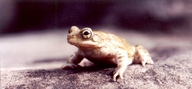
Color: Uniform gray dorsum, with darkish spottings on limbs, ventrum whitish (Eiselt and Schmidtler 1973).
Distribution and Habitat
Country distribution from AmphibiaWeb's database: India, Iran, Islamic Republic of, Pakistan
Bufo olivaceous is recorded from the extreme western parts of Balochistan and adjoining Iran (Eiselt and Schmidtler 1973).
Life History, Abundance, Activity, and Special Behaviors
Larva
Total length 24 - 26, tail 20 - 22 mm. Typically bufonid, with oval, bulging body and weak tail. The oral disc is typically bufonid, labial tooth row formula 2(2)/3, oral papillae are lateral (Eiselt and Schmidtler 1973).
Body is light brown, with dark specks on tail and fins, ventrum darkish white (Eiselt and Schmidtler 1973).
The tadpole feeds on algal vegetation and other concretions deposited on the surface of submerged objects (Eiselt and Schmidtler 1973).
It inhabits ponds and puddles in oasis and date palm groves in Dalbandin and Kharan, southwestern Balochistan (Eiselt and Schmidtler 1973).
Trends and Threats
Prolonged droughts, chemical pollution, pesticides (Eiselt and Schmidtler 1973).
Relation to Humans
Depends on wetlands created by agricultural activity, around salt lakes. It extends in human inhabitations, feeding on light attracted insects (Eiselt and Schmidtler 1973).
Possible reasons for amphibian decline Prolonged drought
Drainage of habitat
Local pesticides, fertilizers, and pollutants
Comments
For references in the text, see here
References
Eiselt, V.J. and Schmidtler, J.F. (1973). ''Froschlurche aus dem Iran unter Berucksichtigung ausseriranischer Populations-gruppen.'' Annals Naturhistorische Museum Wien, 77, 181-243.
Originally submitted by: M. S. Khan (first posted 2002-03-19)
Edited by: vtv (2025-09-08)Species Account Citation: AmphibiaWeb 2025 Duttaphrynus olivaceus: Olive Toad <https://amphibiaweb.org/species/244> University of California, Berkeley, CA, USA. Accessed May 27, 2026.
Feedback or comments about this page.
Citation: AmphibiaWeb. 2026. <https://amphibiaweb.org> University of California, Berkeley, CA, USA. Accessed 27 May 2026.
AmphibiaWeb's policy on data use.
|