|
Description
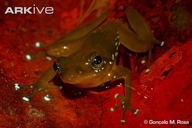
Diagnosis and Description: Blommersia angolafa is a small frog, with a body size of 17–21 mm, enlarged tips on fingers and toes (less developed in other species of Blommersia), and lacks any dark area in the tympanic and frenal region, (present in other species of Blommersia). The following set of characteristic features also assign this species to the genus Blommersia: patch-like femoral glands of type 2 in males, presence of weakly expressed webbing between toes, presence of small-sized inner and outer metatarsal tubercles and a single and moderately distensible subgular vocal sac.
Similar species: see B. grandisonae. Although both B. angolafa and B. grandisonae have enlarged finger tips, they are much more developed in B. angolafa.
Coloration and Variation: B. angolafa has a rather uniform dorso-lateral colouration, shading from yellowish–light brownish to dark brown, with light-bluish spots on the flanks and light-bluish terminal parts of the fingers and toes. The species also appears to be chromatically sexually dimorphic. Males differ from females in having a light colouration, while females are more brownish. After 2 years in preservative, the back has faded to light–yellowish shading to whitish, with a rather indistinct pattern of white spots on the flanks. The white-coloured tips of fingers and toes are no longer evident.
Distribution and Habitat
Country distribution from AmphibiaWeb's database: Madagascar
Blommersia angolafa occurs at four forest blocks in eastern Madagascar: Masoala, Ambatovaky, Zahamena and Betampona and occupies rainforest with an elevational range between 90 m (Ankavanana River, PN de Masoala) and 508 m (Vohitsivalana, RNI de Betampona). It is found both in primary and secondary forest, due to the occurrence of some Dypsis palms in secondary rainforest at Betampona. The observed elevational distribution at Betampona ranged from 332–548 m asl. The authors suspect that this species may also occur at other rainforest sites that fall within this elevational and latitudinal range for eastern Madagascar, such as Makira and Mananara-Nord.Life History, Abundance, Activity, and Special Behaviors
A peculiar aspect characterising this new species is its novel life history and reproductive mode. Both sexes live and breed in a phytotelmic habitat of water accumulated within fallen prophylls and fallen leaf sheaths of at least three species of Dypsis palms. Within these phytotelmata, egg laying and complete larval development occur. Individuals were never observed outside those dead fallen Dypsis phytotelmata that were laying on the forest floor or that contained rainfall.
Calling begins at the end of September and takes place almost continuously until the end of February to early March. Calling males are usually heard during dusk and early at night.
Call (from Betampona): The advertisement call of B. angolafa consists of two notes, rather similar to those described for B. grandisonae and B. domerguei. Note of type 1 is a long and clearly pulsed note with a duration of 221–233 ms and consisting of 9–11 pulses that are repeated with a pulse repetition rate of 44–52 per second. One such pulsed note is followed by an irregular series of up to 13–29 notes of type 2 which are shorter and of irregular structure. Notes of type 2 can be short clicks consisting of a single main pulse and with a duration of 10–17 ms (n=2) or can consist of up to eight distinctly separated pulses each and then have durations of 63–86 ms, with all intermediate states occurring so that a clear distinction of further different note types is not possible. Intervals between notes of type 2 in a note series have a duration of 73–191 ms. The frequency appears as a more or less regular band between about 2,500–5,500 Hz; although, the fundamental frequency may be higher than 2,500 Hz.
Eggs and tadpoles: Egg clutches are found only from December onwards; they are glued to the inside walls of palms' dead prophylls filled with water and fallen on the ground. Several different stages of tadpoles can be found sharing the water accumulated within the same fallen prophyll.
Under captive conditions, all the eggs of a single clutch hatched after a period of 7–10 days, and the total duration of the larval development was 57–70 days.
Trends and Threats
So far, we have found B. angolafa only in phytotelmata of Dypsis species, and it is well-known that Dypsis palms are suffering from selective logging and deforestation. Thus, the conservation situation for B. angolafa is potentially and negatively affected by the palms' threatened status. Most of the Dypsis palms (or at least D. lastelliana) are also threatened by selective logging habitat destruction, fire, harvesting for palm heart, and plant and seed collection by palm enthusiasts. The authors recommend that this species be classified under IUCN criteria as Vulnerable (VU). Possible reasons for amphibian decline General habitat alteration and loss
Habitat modification from deforestation, or logging related activities
Intensified agriculture or grazing
Habitat fragmentation
Comments
Phylogenetic Relationships: The authors consider the reproductive mode of B. angolafa as a derived character, having evolved from the more typical reproduction in lentic water bodies. The general scarcity of lentic habitats in Malagasy rainforests may have provided the conditions that favoured the evolution of this phytotelmic breeding strategy.
Etymology: One of the authors (C. J. Raxworthy) first used this name when he found the new Blommersia at Masoala. The term “angolafa” or “angolafo” is the Malagasy vernacular name used at that region by the Betsimisaraka people for the Dypsis palm species (mostly for Dypsis lastelliana), whose leaves and prophylls are used by the new Blommersia species.
References
Andreone, F., Rosa, G. M., Noël, J., Crottini, A., Vences, M., and Raxworthy, C. J. (2010). ''Living within fallen palm leaves: the discovery of an unknown Blommersia (Mantellidae: Anura) reveals a new reproductive strategy in the amphibians of Madagascar.'' Naturwissenschaften, published online 17 April 2010; DOI 10.1007/s00114-010-0667-x.
Originally submitted by: Gonçalo M. Rosa and Franco Andreone (first posted 2010-05-12)
Edited by: Kellie Whittaker (2010-05-18)Species Account Citation: AmphibiaWeb 2010 Blommersia angolafa <https://amphibiaweb.org/species/7489> University of California, Berkeley, CA, USA. Accessed Apr 25, 2024.
Feedback or comments about this page.
Citation: AmphibiaWeb. 2024. <https://amphibiaweb.org> University of California, Berkeley, CA, USA. Accessed 25 Apr 2024.
AmphibiaWeb's policy on data use.
|




 Map of Life