|
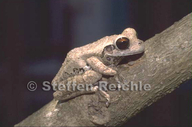
Osteocephalus pearsoni
| family: Hylidae subfamily: Hylinae |
![]() © 2009 José M. Padial (1 of 2) |
Country distribution from AmphibiaWeb's database: Bolivia, Brazil, Peru
IUCN (Red List) status: Least Concern (LC). |
|
Range Description This species is found in the Upper Amazon Basin and lower Andean slopes, Departments of Madre de Dios and Puno, Peru; Departments of Beni and La Paz, Bolivia; also present in Rondonia, Brazil. It is present from 200-1,000m asl. Habitat and Ecology It is present in lowland tropical moist forest; generally in open lakes and swampy areas within, or close to, forest. It possibly occurs in palm tree savannah. Its eggs are laid in shallow pools. Population It is abundant where it is present. Population Trend Unknown Major Threats There are no major threats, it is a widespread species with large areas of suitable habitat remaining. There is some localized habitat loss to general human activities such as agriculture (crops, livestock etc.). Conservation Actions Within Peru this species might occur in the Tambopata National Reserve (Doan and Arizábal, 2002). Given its habitat and geographic distribution it might also occur in Apurimac Reserved Zone, Manu Biosphere Reserve, Amarakaeri Reserved Zone and Bahuaja Sonene National Park. It is also present in protected areas within Bolivia. Citation Ariadne Angulo, Karl-Heinz Jungfer, Steffen Reichle, Ignacio De la Riva 2004. Osteocephalus pearsoni. In: IUCN 2012
|