Dicamptodontidae |  |
4 species in 1 genus
Commonly Called Giant Salamanders
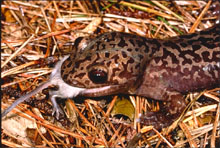
Dicamptodon ensatus
Photo by Harry Greene
(Click for family gallery)Medium to large terrestrial salamanders, known from the western United States. Largest living terrestrial salamanders, with Dicamptodon reaching up to 351 mm. The aquatic larvae require 2 to 4.5 years to reach metamorphosis. Members of this family are restricted to wooded areas that have clear, permanent streams where their larvae can metamorphose. Tending to be nocturnal, they can also be found in dark, heavy canopied forest (usually redwood or Douglas fir) during the day. Large metamorphosed individuals can be aggressive and may cause you to bleed if bitten. They are also known to eat small mammals. Adults can produce a "barking" noise.
Written by AmphibiaWebNotable Family Characteristics
- Inhabits moist forests in the Pacific Northwest
- Some morphological characters are: 1) vomerine teeth in "M" shape; 2) lacrimal present; 3) marbled dorsal patterns.
- Terrestrial
- Eggs hatch into aquatic larvae which can live in perennial streams up to 4 or more years before metamorphosis
- Distribution limited to the Pacific Northwest and the San Francisco Bay Area of western North America

Cartography Credit: Zoe Yoo, UC Berkeley
Range maps sources: AmphibiaWeb, UC Berkeley, and IUCN RedListRelevant Reference
Blackburn, D. C., and D. B. Wake. 2011. Class Amphibia Gray, 1825. Zhang, Z.-q. ed., Animal biodiversity: An outline of higher-level classification and survey of taxonomic richness. Zootaxa 3148: 39–55.
Larson, Allan. 1996. Dicamptodontidae. Pacific Giant Salamanders. Version 01 January 1996. http://tolweb.org/Dicamptodontidae/15447/1996.01.01 in The Tree of Life Web Project, http://tolweb.org/
Genus Dicamptodon (4 species)
Dicamptodon aterrimus account photos no sound/video Dicamptodon copei account photos no sound/video Dicamptodon ensatus account photos sound/video Dicamptodon tenebrosus account photos no sound/video
Citation: AmphibiaWeb: Information on amphibian biology and conservation. [web application]. Berkeley, California: AmphibiaWeb. Available: https://amphibiaweb.org/. (Accessed:
AmphibiaWeb's policy on data use.