|
Vernacular Name
Ranita arbórea grillo
State/Provinces
Los Ríos, Manabí
Natural Regions
Bosque Húmedo Tropical del Chocó
Identification
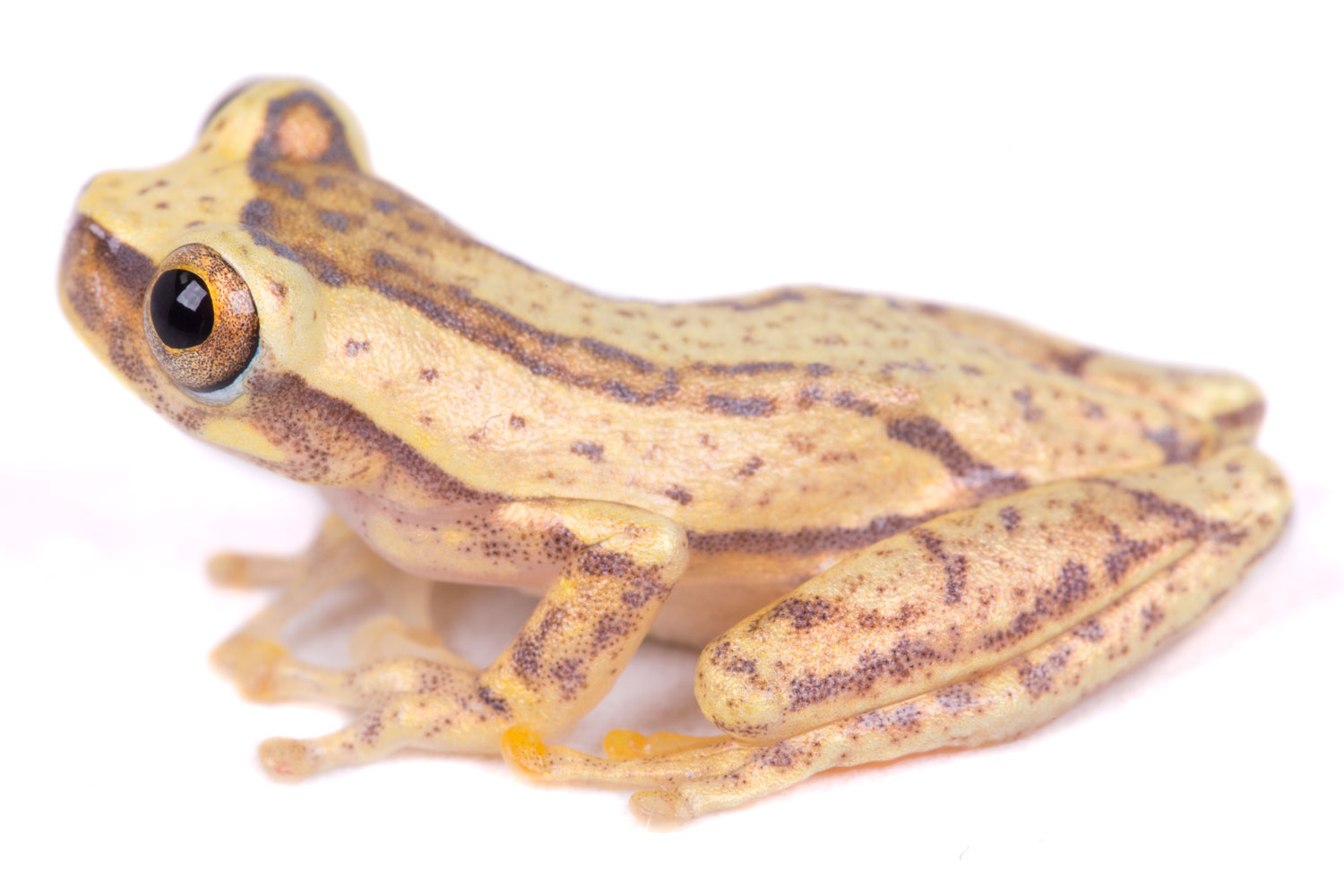
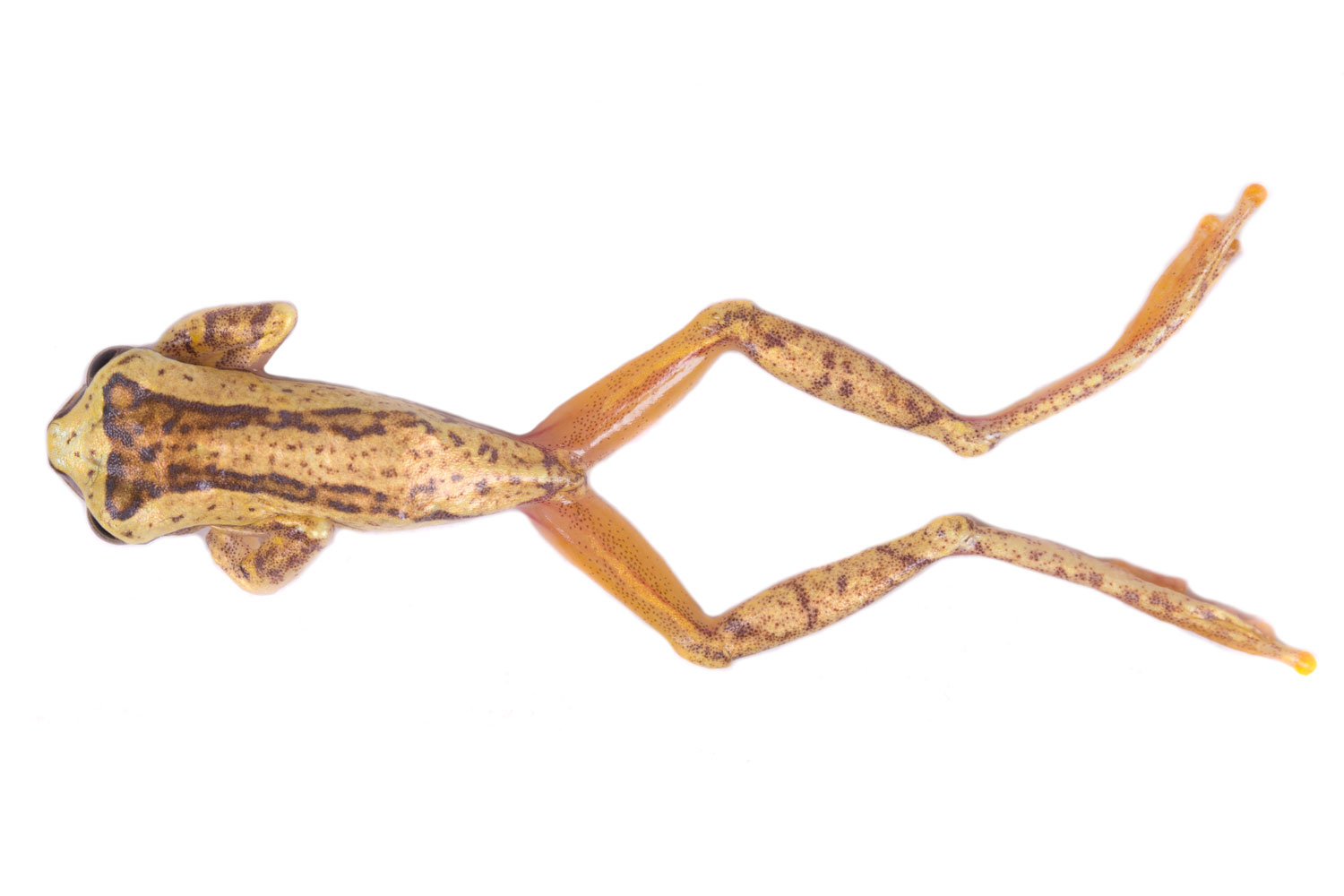
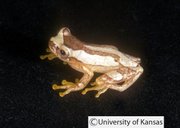
Rana pequeña que se caracteriza por tener una marca media dorsal marrón oscura, amplia, rectangular, en forma de "n"; raya dorsolateral marrón estrecha, oscura que se extiende hasta o casi hasta la ingle; barras transversales de color marrón oscuro en las extremidades; y una estrecha línea blanca a lo largo del canto rostral, borde de los párpados, y en algunos especímenes posterior al pliegue supratimpánico. Al igual que Dendropsophus gryllatus Dendropsophus ebraccatus presenta una marca oscura media dorsal, pero se diferencia de esta por tener menos membrana en la axila y entre los dedos de la mano (2). Con la excepción de Dendropsophus carnifex, las demás especies de Dendropsophus del Ecuador tienen rangos geográficos restringidos a la cuenca amazónica. Se diferencia de Dendropsophus carnifex por los colores contrastantes entre la mitad anterior y posterior de la cabeza (coloración uniforme en Dendropsophus carnifex). Se diferencia de las especies de Boana de la región Costa de Ecuador por su menor tamaño y por la ausencia de bandas laterales de color claro; la presencia de membranas entre los dedos de los pies la diferencian fácilmente de las especies de Pristimantis.
Description
Es una rana de tamaño pequeño con la siguiente combinación de caracteres (modificada de Duellman (2)): (1) cabeza más ancha que el cuerpo; (2) hocico corto, truncado en vista dorsal; punta del hocico proyectada levemente más allá del margen del labio; canto rostral redondeado; región loreal apenas cóncava; (3) narinas no protuberantes, separadas por ¾ la distancia de la órbita a la punta del hocico; área internarial plana; labios redondeados; (4) ojos grandes, protuberantes, dirigidos anterolateralmente; región interorbital plana; (5) pliegue supratimpánico poco conspicuo, cubriendo el borde superior del tímpano; anillo timpánico poco conspicuo o ausente; tímpano se separa del ojo por una distancia igual o hasta dos veces el diámetro del tímpano; (6) membrana axilar se extiende cerca de ⅓ de la longitud del brazo; antebrazo robusto, sin pliegue ulnar ni tubérculos; (7) dedos manuales cortos, con discos grandes; diámetro del disco del Dedo III dos veces el diámetro del tímpano; (8) longitud realativa de los dedos manuales: I < II < IV < III; prepólex sin excrescencia nupcial; membranas se extienden hasta la base de las penúltimas falanges de los Dedos I, II y IV, y hasta el centro de la antepenúltima falange del Dedo III; (9) patas traseras moderadamente delgadas, sin pliegue o tubérculo en el talón, poseen pliegues tarsales y un tubérculo metatarsiano externo; tubérculo metatarsiano interno grande, diagonalmente elíptico, no visible desde arriba; (10) dedos del pie moderadamente largos, con discos un poco más pequeños que aquellos en los dedos de la mano; (11) longitud relativa de los dedos pediales: I < II < III < V < IV; membranas se extienden desde la base del disco del Dedo I hasta la base de la penúltima falange del II, desde la base del disco del Dedo II hasta la base de la penúltima falange del III, desde la base del disco del Dedo III hasta la base de la penúltima falange del IV y junto a la base del disco del Dedo V; (12) piel en vientre y superficies posteroventrales próximas de muslos granular; piel en otras superficies lisa; (13) saco vocal único, mediano, subgular, bastante extensible; cuando se infla se extiende hasta la axila.
Color in Life
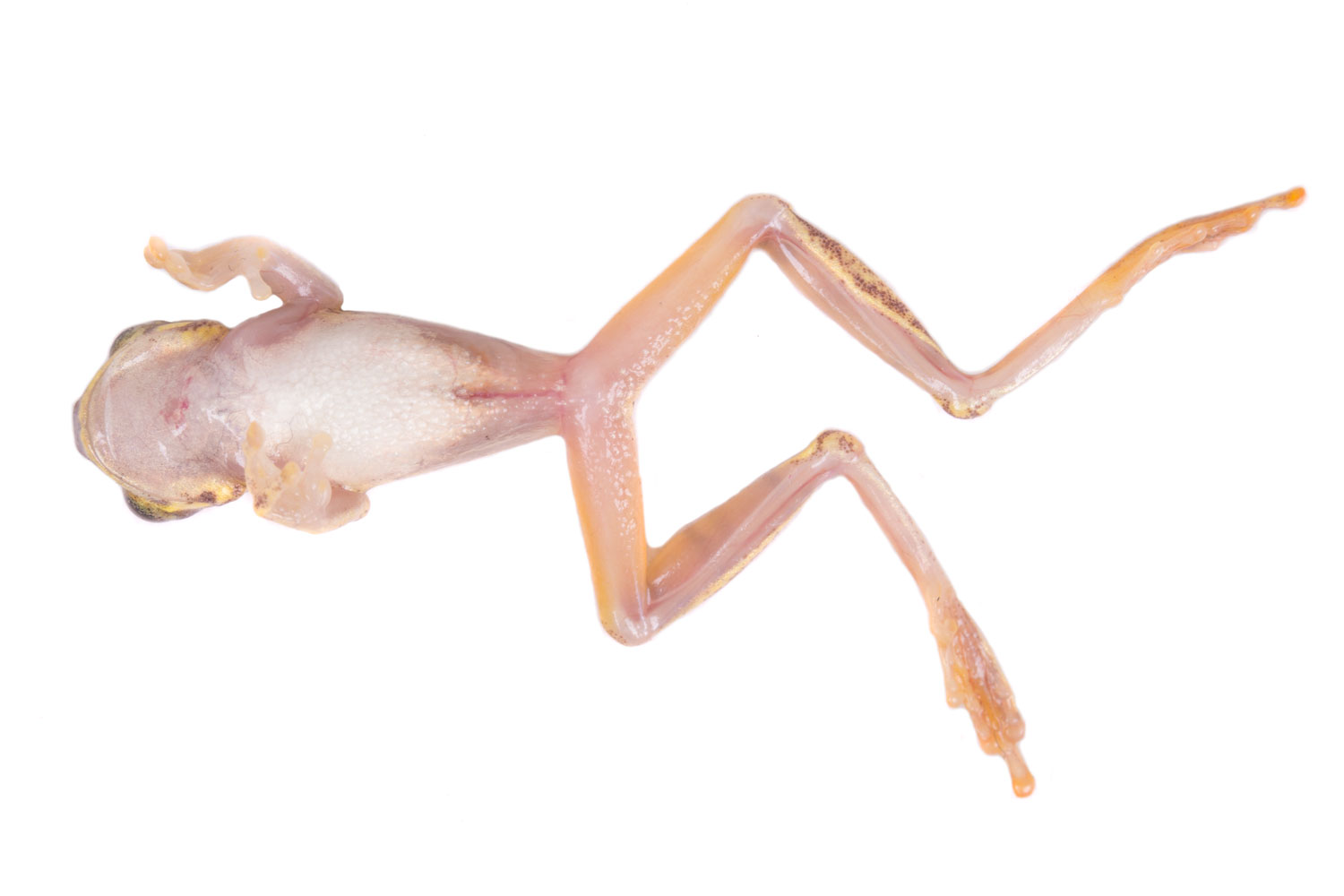
Dorso amarillo-marrón con una marca en el medio de color marrón oscura amplia y rectangular con un borde anterior recto y un borde posterior profundamente curvado, dando como resultado una marca en forma de “n” con una base gruesa en algunos especímenes; muslos, manos y pies naranja pálidos; vientre blanco; superficies ventrales de muslos y piernas carecen de pigmento con barras transversales marrón oscuras; saco vocal amarillo; iris bronce (2).
Males Face Cloacal Length Average
promedio = 23.7 mm (rango 22.6–25.5; n=20) (2
Females Face Cloacal Length Average
promedio = 29.2 mm (rango 27.5–30.6; n=5) (2
Habitat and Biology
Se la ha registrado en una charca grande con plantas acuáticas del género Lemna, en una plantación de banano, donde individuos cantaban desde los arbustos al borde del agua. Algunos individuos fueron encontrados en las hierbas que sobresalían de piscinas fangosas poco profundas. La charca era una depresión natural y estaba a cerca de 1 km del bosque. Una búsqueda extensa en el bosque tropical adyacente no reveló ningún individuo. El canto consiste en un “creek-eek-eek” parecido al sonido de un grillo. Se ha encontrado en simpatría con Boana pellucens, Scinax quinquefasciata, Scinax sugillatus, Agalychnis litodryas, Trachycephalus jordani, Bufo marinus, Leptodactylus ventrimaculatus y Rana palmipes (2).
Distribution
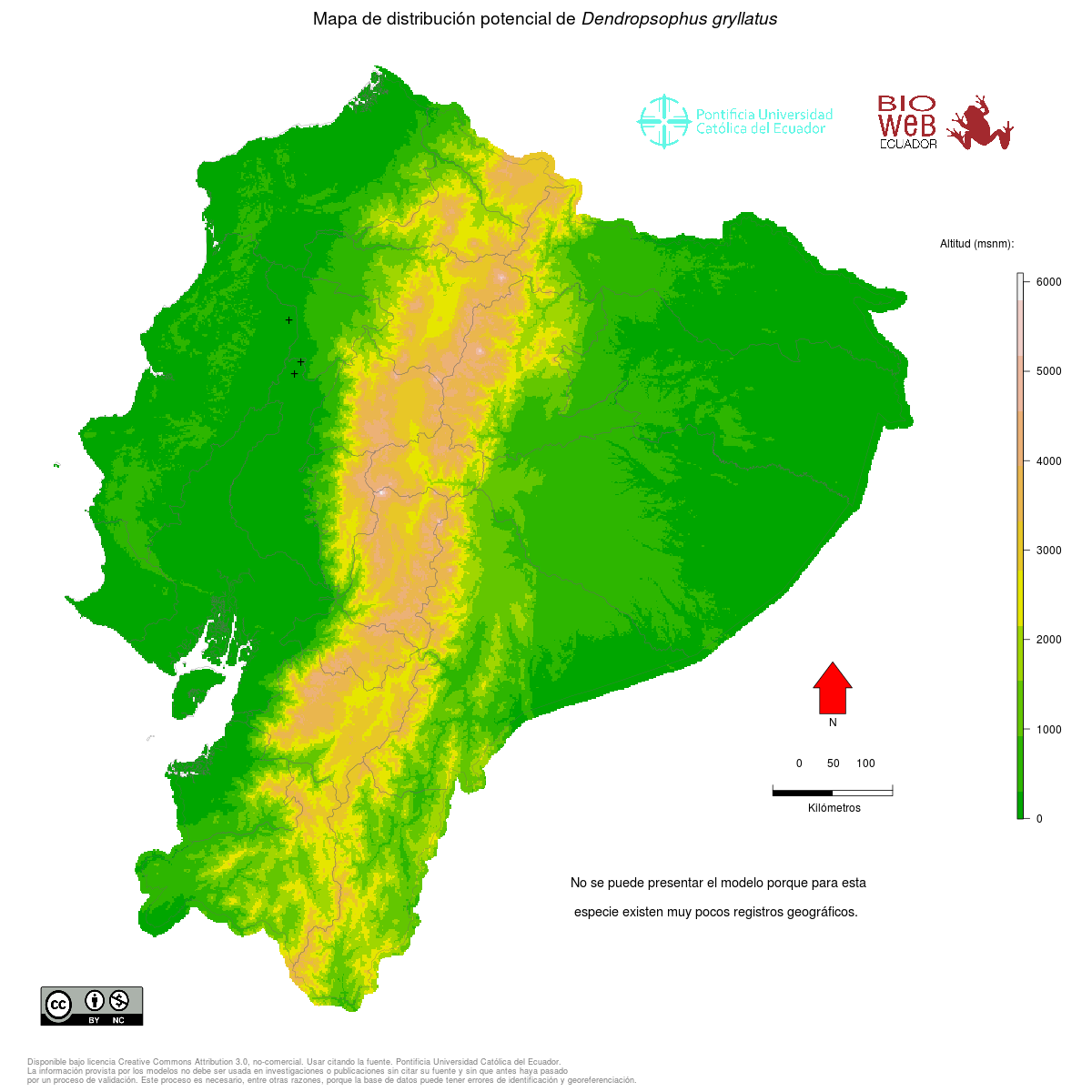
Se distribuye en las tierras bajas pacíficas noroccidentales del Ecuador (6).
Altitudinal Range
Se encuentra de 200 a 500 m sobre el nivel del mar (6).
Taxonomy and Evolutionary Relationships
En base a caracteres genéticos se la ubicó dentro del grupo de especies Dendropsophus microcephalus (3). El grupo contiene 33 especies y está representado en el Ecuador por dos especies: Dendropsophus gryllatus y Dendropsophus rhodopeplus. La monofilia del grupo microcephalus se confirmó en el análisis de Wiens et al. (1), sin embargo también se incluyó en este clado a Dendropsophus riveroi. Cabe recalcar que ni Faivovich et al. (3) ni Wiens et al. (1) incluyeron Dendropsophus gryllatus en sus análisis. Ver sinonimia en Frost (5).
Etymology
El epíteto específico es la palabra en latín gryllatus, que significa "chirrido" o "grillo", y hace referencia al canto de apareamiento de esta especie (2).
Additional Information
El canto es descrito por Duellman (2). Ver foto, mapa, descripción de la distribución geográfica, hábitat y estatus de conservación en Stuart et al. (4).
Summary Author
Santiago R. Ron, Morley Read y Gabriela Pazmiño-Armijos
Editor
Santiago R. Ron
Edition Date
2012-01-04T00:00:00
Update Date
2022-09-23T14:15:41.483
Literature Cited
Wiens, J. J., Kuczynski, C. A., Hua, X. y Moen, D. S. 2010. An expanded phylogeny of treefrogs (Hylidae) based on nuclear and mitochondrial sequence data. Molecular Phylogenetics and Evolution 55:871-882.PDF Duellman, W. E. 1973. Descriptions of new hylid frogs from Colombia and Ecuador. Herpetologica 29:219-227.PDF Faivovich, J., Haddad, C. F., García, P. C., Frost, D. R., Campbell, J. A. y Wheeler, W. C. 2005. Systematic review of the frog family Hylidae, with special reference to Hylinae: phylogenetic analysis and taxonomic revision. Bulletin of the American Museum of Natural History 294:1-240.PDF Stuart, S. N., Hoffmann, M., Chanson, J., Cox, N., Berridge, R., Ramani, P. y Young, B (eds.). 2008. Threatened Amphibians of the World. Lynx Edicions. España xv+758pp. Frost, D. R. 2016. Amphibian Species of the World: an Online Reference. Version 6.0 (Date of access). Electronic Database accessible at http://research.amnh.org/herpetology/amphibia/index.html. American Museum of Natural History, New York, USA. Coloma, L. A., Ron, S. R., Cisneros-Heredia, D., Almendariz, A. 2004. Dendropsophus gryllatus. The IUCN Red List of Threatened Species 2004: e.T55496A11309678. http://dx.doi.org/10.2305/IUCN.UK.2004.RLTS.T55496A11309678.en. Downloaded on 27 August 2018.
|




 Map of Life