
|
Chimerella mariaelenae (Cisneros-Heredia & McDiarmid, 2006)
Maria Elena's Glassfrog, Rana de Cristal de María Elena | family: Centrolenidae subfamily: Centroleninae genus: Chimerella |
| Species Description: Cisneros-Heredia DF, McDiarmid RW 2006 A new species of the genus Centrolene (Amphibia: Anura: Centrolenidae) from Ecuador with comments on the taxonomy and biogeography of Glassfrogs. Zootaxa 1244:1-32 | |
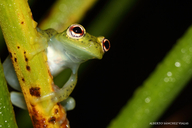 © 2017 Alberto Sanchez-Vialas (1 of 5) |
|
|


|
Description Chimerella mariaelenae is a glass frog, described from two specimens, one male specimen has a snout-vent length of 19.0 mm (Cisneros-Heredia and McDiarmid 2006) and a female specimen has a snout vent length of 20.3 mm (Cisneros-Heredia 2009). Its head is wider than it is long. The snout is short and blunt in dorsal view and short in profile. The internarial region is indentated and the nostrils protrude. Though the canthus rostralis is rounded it is not distinct and a shallow platform forms between canthus rostralis. The loreal region is rounded and the lips are slightly flared. The eyes are large and are anterolateral at about 39° from the center making them visible from below. The tympanum is posterior and lateral in position with a slight dorsal inclination, and is separated from the eye by a distance almost equivalent to the diameter of the tympanum. Though the tympanic annulus is not distinct, it is slightly elevated interiorly and ventrally. There is a weak supratympanic fold. The tongue is long and ovoid, and not adherent posteriorly and laterally (Cisneros-Heredia and McDiarmid 2006). The skin of the dorsal surface of head, body, limbs, belly, and ventral surfaces are rough and granulated. The cloacal opening is directed posteriorly at upper side of the thighs, with no distinct sheath. A pair of rounded, large, flat tubercles are on the ventral surfaces of thighs below the vent with no other ornament in this region. The ventral skin is not enameled (Cisneros-Heredia and McDiarmid 2006). Chimerella mariaelenae has a visible parietal peritoneum but the hepatic peritoneum is covered by guanophores (Noonan and Harvey 2000; Duellman and Senaris 2003). The upper arms in C. mariaelenae are thin and half the width of the robust forearm. A humeral spine is present, but ulnar folds and tubercles are not. The relative lengths of the fingers are II < I < IV < III. There is basal webbing between II and III as well as between III and IV (III 2 1/2 - 2 1/2 IV). There is no bulla present in the finger webbing and lateral fringes are only present in III and IV. The finger discs are truncated and wide in diameter. Finger III has a larger disk than those on the toes, but its shorter in diameter than its eyes. The subarticular tubercles are rounded and elevated, while the supernumerary tubercles are small and indistinct. The tenar tubercle is also indistinct. Conversely, the palmar tubercles are large, ovoid, and flat. There is no protruding prepollical spine. The nuptial excrescences are a granular pad, sometimes with glandular clusters or individual glands (Cisneros-Heredia and McDiarmid 2006). The hind limbs are slender and when the limbs are perpendicular to body the heels touch but do not overlap one another. Fringes and tarsal folds are not present. There is a small elliptical, but indistinct inner metatarsal. The outer metatarsal is absent. The supernumerary tubercles are small and indistinct. The webbing formula for the foot is I 2-- 2 1/2 II 2- 3 III 2 - 3 IV 2 2/3- 1 2/3 V and there are lateral fringes on the IV toe. The disc on toe I is round but not expanded and all other discs are bluntly truncated with a rounded projection on the first toe (Cisneros-Heredia and McDiarmid 2006). At stage 39, the body of the tadpoles are longer and wider than they are high. The total length is approximately 35.5 mm and the body length is about 9.9 mm. The snout is rounded in both the dorsal and lateral views. A lateral line system is visible and appears as several stitches that are perpendicular or parallel to the center of the body. A discontinuous line is formed by these stitches. The distance between the eyes is 2.9 mm and the small narial apertures are at a distance of 1.9 mm from the tip of the snout. The distance between the centers of narial apertures is 2.2 mm. The oral disk is medium sized relative to the body length, the oral disk width is 2.6 mm. It is not emarginate or anteroventral. There are 49 marginal uniserial ventral and lateral papillae. The lengths of lateral papillae are 0.04 – 0.16 mm with a width of 0.07 – 0.16 mm. The lengths of ventral papillae are 0.02 – 0.16 mm and have a width 0.07 – 0.18 mm. The upper and lower jaw sheaths are straight, completely keratinized, and have a serrated edge. The upper jaw sheath has a width of 1.3 mm, which is slightly wider than the lower jaw width that is 1 mm. The teeth rows are equal in length. In stages 41 and 42 the teeth are replaced by ridges and stage 41 has few teeth on the rows. There is a short spiracle on the left side of the posterolateral region of body. The myotomes are visible throughout the entire tail. Dorsal and ventral myotomes are separated by a straight medial line. The dorsal fin arises from about the midpoint of the tail. This fin is uniform in height until the distal end, where there is a stark decrease in size. The ventral fin arises from the base of the tail and reaches its maximum height after the midpoint of the tail (Valdez and Guayasamin 2014). Chimerella mariaelenae is the only know Andean centrolenid frog that has a humeral spine, transparent guanophores, and a parietal peritoneum. The guanophores cover the hepatic, visceral and pericardial periotnea, which is typical of the Centrolene gorzulai species group that is local to Guayana and the Guayana Region of eastern Venezuela. Other members have guanophores that wrap around the heart in a bib-like fashion unlike C. mariaelenae. The parietal peritoneum is also a different color in C. mariaelenae than in others in the Centrolene gorzulai species group. More specifically, in the dorsal view, C. mariaelenae has a blunt snout like that of Centrolene papillahallicum but can be differentiated from Centrolene gorzulai, and Centrolene lema by their having a subtruncated snout. Chimerella mariaelenae can be further differentiated from C. lema by the former having less inter-digital webbing. Chimerella mariaelenae has differing relative finger lengths than C. papillahallicum and it lacks the melanophores scattered around its fingers and toes that C. papillahallicum possess (Cisneros-Heredia and McDiarmid 2006). From its sister species, Chimerella corleone, C. mariaelenae differs in that C. corleone has eggs that have a smoky jelly while C. mariaelenae produces a clear jelly. Chimerella mariaelenae also has red and black eyes and a lighter green dorsal that differs from the gray eyes and dark green dorsum of C. corleone (Twomey et al. 2014). Comparisons between tadpoles of centrolenid species are difficult because there are few descriptions and they are primarily based on few individuals in early Gosner stages (Valdez and Guayasamin 2014). In preservation, the adult dorsum has numerous dark lavender spots and larger flecks (Cisneros-Heredia and McDiarmid 2006). The background color seems to be a dark olive color due to the fluid used to preserve the specimen (Cisneros-Heredia 2009). The venter is cream. The bones become white, but are possibly green in life like members of C. gorzulai species group. The parietal peritoneum is transparent and lacks guanophores that are in a bib formation. The pericardial, hepatic and visceral peritonea sclera and testes are white in coloration. The gall and urinary bladders are transparent as well (Cisneros-Heredia and McDiarmid 2006). In life, tadpoles at stage 39 have an overall brown hue but has two areas without pigmentation at the anterolateral border of the eye. The anterior half of the dorsum is red with some transparency. The most anterior part of the head is gray. There is iridophore aggregations on the dorsum, and along the vertebral column. The iris is a bronze color. Starting at stage 40 the body is brown, but can have green slight pigmentation. Stage 41 and 42 individuals are either yellow to green or blue to green and no longer have brown coloration. The snout is blue-green and the tail remains brown. The eyes resemble that of the adult and irises are red in color. Although there is variation among individuals at the same stage, C. mariaelenae presents an increment in the number of papillae (Valdez and Guayasamin 2014). In preservation, the tadpole at stage 39 is a cream color and has several brown dots on the dorsum. The venter is transparent and has some white spots that become more abundant posteriorly. Dorsally, the tail is brown. In the lateral view, the myotomes are brown and fade in coloration as they move down the length of tail. The dorsal fin and ventral fin have brown spotting but the ventral fin only has spotting next to caudal musculature. At stages 41 and 42 the brown coloration of the dorsum is only on the middorsal region of the body. There are five iridophore aggregations on the beginning of the caudal musculature on the dorsum. The shanks have some brown spotting on the dorsum (Valdez and Guayasamin 2014). There is no significant variation in Chimerella mariaelenae (Cisneros-Heredia 2009). Distribution and Habitat Country distribution from AmphibiaWeb's database: Ecuador, Peru
Chimerella mariaelenae occurs at elevations of at least 1400 to 1820 m (Guayasamin et al. 2009), inhabiting the cloud forests on the eastern side of the Cordillera Oriental, province of Zamora-Chinchipe, Andes of Ecuador. It is known from three locations on the Amazonian slopes (Cisneros-Heredia 2009) and in 2011 the species was found in abundance in Cordillera Kampankis, Zona Reservada Santiago-Comaina, Peru (Catenazzi and Venegas 2012). Life History, Abundance, Activity, and Special Behaviors Chimerella mariaelenae is nocturnal (Valdez and Guayasamin 2014). During the non-reproductive period the species appears to inhabit the forest canopy (Twomey et al. 2014). Egg clutches are found on the upper side of leaves high above the ground in November (Valdez and Guayasamin 2014). Trends and Threats Chimerella mariaelenae was originally thought to be rare, however further research has revealed that it is common. A healthy subpopulation occurs around Cordillera Kampankis, Zona Reservada Santiago-Comaina, Peru, where 50 individuals were observed within an hour of searching in 2011 (Catenazzi and Venegas 2012). Chimerella mariaelenae is listed as “Least Concern” by the IUCN Redlist because it is widespread, has a large relative abundance, and is adaptable to climate change. Additionally, it occurs in an area that does not appears to be under significant threat and is found within several protected areas, including Podocarpus National Park, Parque Nacional Sangay, Cayambe-Coca Ecological Reserve and Zona Reservada Santiago-Comaina (IUCN 2018). Possible reasons for amphibian decline General habitat alteration and loss Comments Originally, C. mariaelenae was described as Centrolene mariaelenae. The transparent ventral parietal peritoneum and white hepatic peritoneum are traits that caused Cisneros-Heredia and McDiarmid to argue that Chimerella mariaelenae was a part of Centrolene gorzulai species group that is local to the Guiana Shield. Biogeographic similarities were also used as evidence. However, the relationship between Chimerella mariaelenae and other genera within the tribe, Cochranellini, was not strongly supported in topologies obtained from Baysian Inference, Maximum Likelihood, and Maximum Parsimony analyses of 12S rRNA, 16S rRNA, ND1 mitochondrial DNA, POMC nuclear DNA, c-myc nuclear DNA and RAG1 nuclear DNA. Futhermore, the phylogeny did not support the Andes-Guiana Shield hypothesis. However, the results did identify Cochranellini as the most recent common ancestor of the genus, Chimerella. Both morphological and behavioral similarities support this releationship to species in Chimerella and Vitreorana. (Guayasamin et al. 2009). Chimerella corleone is the only other known member of the genus Chimerella and was placed into this genus based on phylogenetic analyses of mitochondrial genes 12S and 16S. Chimerella corleone shares several characteristics with Chimerella mariaelenae; presence of humeral spine in adult males, absence of vomerine teeth, presence of green bones, presence of transparent parietal peritoneum (no bib-like patch visible), presence of bulbous liver with rounded lobes, presence of white hepatic, cardiac, and visceral peritonea, and lastly males normally vocalize from upper surfaces of leaves (Twomey et al. 2014). The name Chimerella comes from the Greek “Chimaira”. The Chimera is creature in greek mythology that is composed of many animals. This name refers to how many combinations of peculiar morphological traits are present in Chimerella mariaelenae (Guayasamin et al. 2009). The species epithet “mariaelenae” was chosen to honor Maria Elena Heredia, D. F. Cisneros-Heredia's mother in recognition of her support of her son’s herpetological research (Cisneros-Heredia and McDiarmid 2006).
References
Cisneros-Heredia, D. F. (2009). ''Amphibia, Anura, Centrolenidae, Chimerella mariaelenae (Cisneros-Heredia and McDiarmid, 2006), Rulyrana flavopunctata (Lynch and Duellman, 1973), Teratohyla pulverata (Peters, 1873), and Teratohyla spinosa (Taylor, 1949): Historical records, distribution extension and new provincial record in Ecuador.'' Check List. Journal of Species Lists and Distribution, 5, 912-916. Cisneros-Heredia, D. F., McDiarmid, R. W. (2006). ''A new species of the genus Centrolene (Amphibia: Anura: Centrolenidae) from Ecuador with comments on the taxonomy and biogeography of glassfrogs.'' Zootaxa, 1244, 1-32. Guayasamin, J. M., Castroviejo-Fisher, S., Trueb, L., Ayarzaguena, J., Rada, M., Vila, C. (2009). ''Phylogenetic systematics of glassfrogs (Amphibia: Centrolenidae) and their sister taxon Allophryne ruthveni.'' Zootaxa, 2100, 1-97. IUCN SSC Amphibian Specialist Group (2018). ''Chimerella mariaelenae.'' The IUCN Red List of Threatened Species 2018: e.T135968A516500. http://dx.doi.org/10.2305/IUCN.UK.2018-1.RLTS.T135968A516500.en. Downloaded on 13 November 2018. Twomey, E., Delia, J., Castroviejo-Fisher, S. (2014). ''A review of northern Peruvian glassfrogs (Centrolenidae), with the description of four new remarkable species.'' Zootaxa, 3851, 1-87. Valdez, A.T., Guayasamin, J.M. (2014). ''The Tadpole of the Glassfrog Chimerella mariaelenae (Anura: Centrolenidae).'' Ciencamérica, 3, 6-12. Originally submitted by: Aileen Lavelle (first posted 2018-09-18) Edited by: Ann T. Chang (2019-03-19) Species Account Citation: AmphibiaWeb 2019 Chimerella mariaelenae: Maria Elena's Glassfrog <https://amphibiaweb.org/species/6755> University of California, Berkeley, CA, USA. Accessed Apr 25, 2024.
Feedback or comments about this page.
Citation: AmphibiaWeb. 2024. <https://amphibiaweb.org> University of California, Berkeley, CA, USA. Accessed 25 Apr 2024. AmphibiaWeb's policy on data use. |
 Map of Life