|
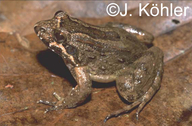
Leptodactylus griseigularis
| family: Leptodactylidae |
![]() © 2003 J. Koehler (1 of 4)
|
Country distribution from AmphibiaWeb's database: Bolivia, Peru
IUCN (Red List) status: Least Concern (LC). |
|
Range Description This species is known from the Andes of southern and central Peru and northern Bolivia. In Peru it occurs on the northeastern slopes of the Andes to central-eastern slopes, encompassing the Departments of Huánuco, Ayacucho, Junin, Pasco, San Martin and Ucayali. In Bolivia it is present in the Departamentos of La Paz and Cochabamba. It has an altitudinal range of 100-1,800m asl. Habitat and Ecology This species can be found in both montane primary and lowland tropical moist forest of the Amazonian slopes and Andes foothills of the Andes. Breeding takes place in foam nests within stagnant waters. Occasionally it is found close to roadside ditches in forest habitat. Population It is an uncommon species. Population Trend Stable Major Threats At present, there are only localized threats to this species. Certain populations are probably impacted by deforestation. Conservation Actions In Bolivia it is present in Madidi and Carrasco protected areas. In Peru this species might occur in Rio Abiseo National Park, Biabo Cordillera Azul Reserved Zone, Tingo Maria and Yanachaga Chemillen National Parks, Yanesha Communal Reserve, Bosque de Proteccion San Matias San Carlos and Apurimac Reserved Zone (although this requires confirmation). There are no conservation measures needed for this species. Citation Ariadne Angulo, Jörn Köhler, Steffen Reichle, Wilfredo Arizabal 2004. Leptodactylus griseigularis. In: IUCN 2012
|