|
Vernacular Name
Cutín bocón de Maldonado
State/Provinces
Carchi, Esmeraldas
Natural Regions
Bosque Piemontano Occidental, Bosque Montano Occidental
Identification
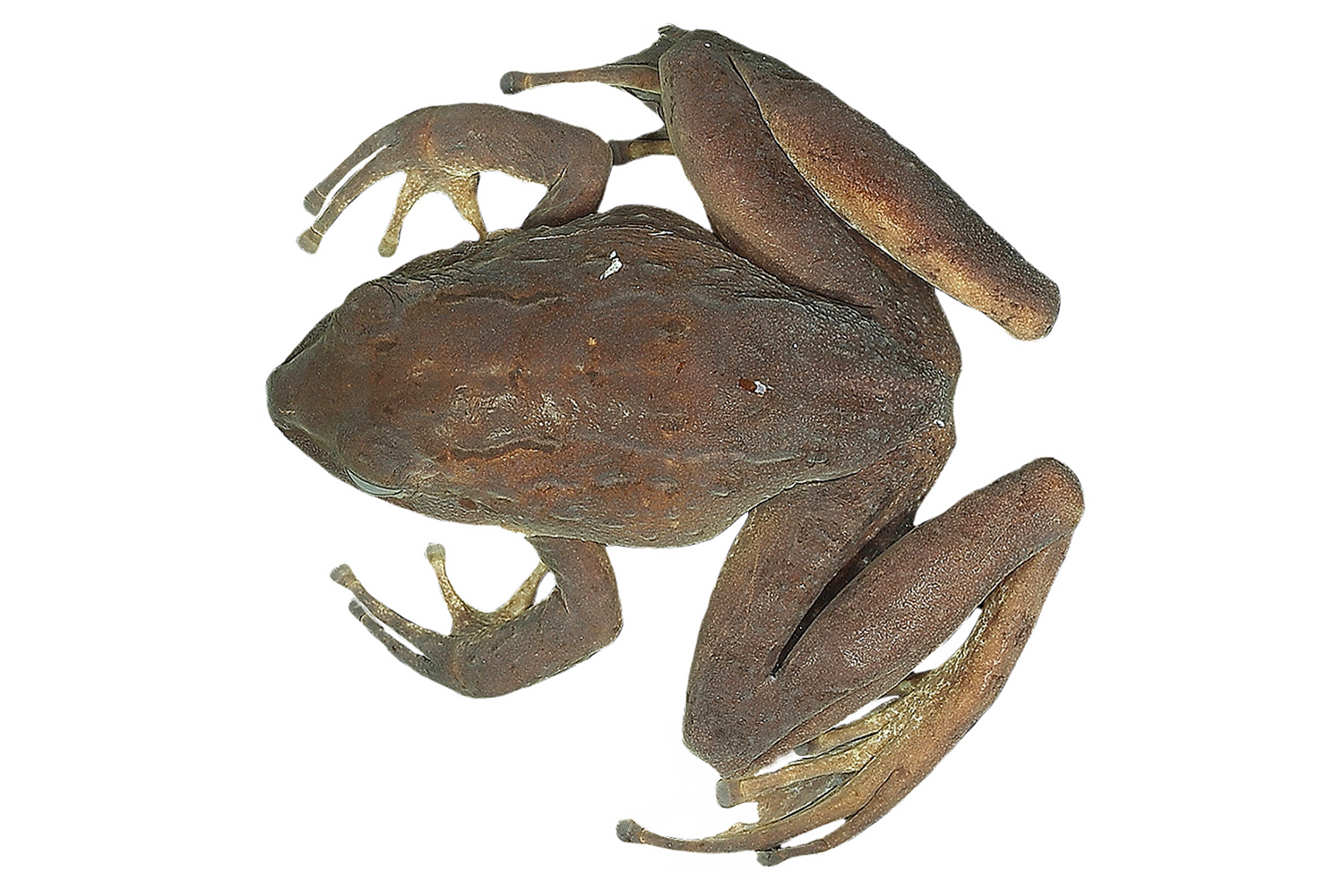
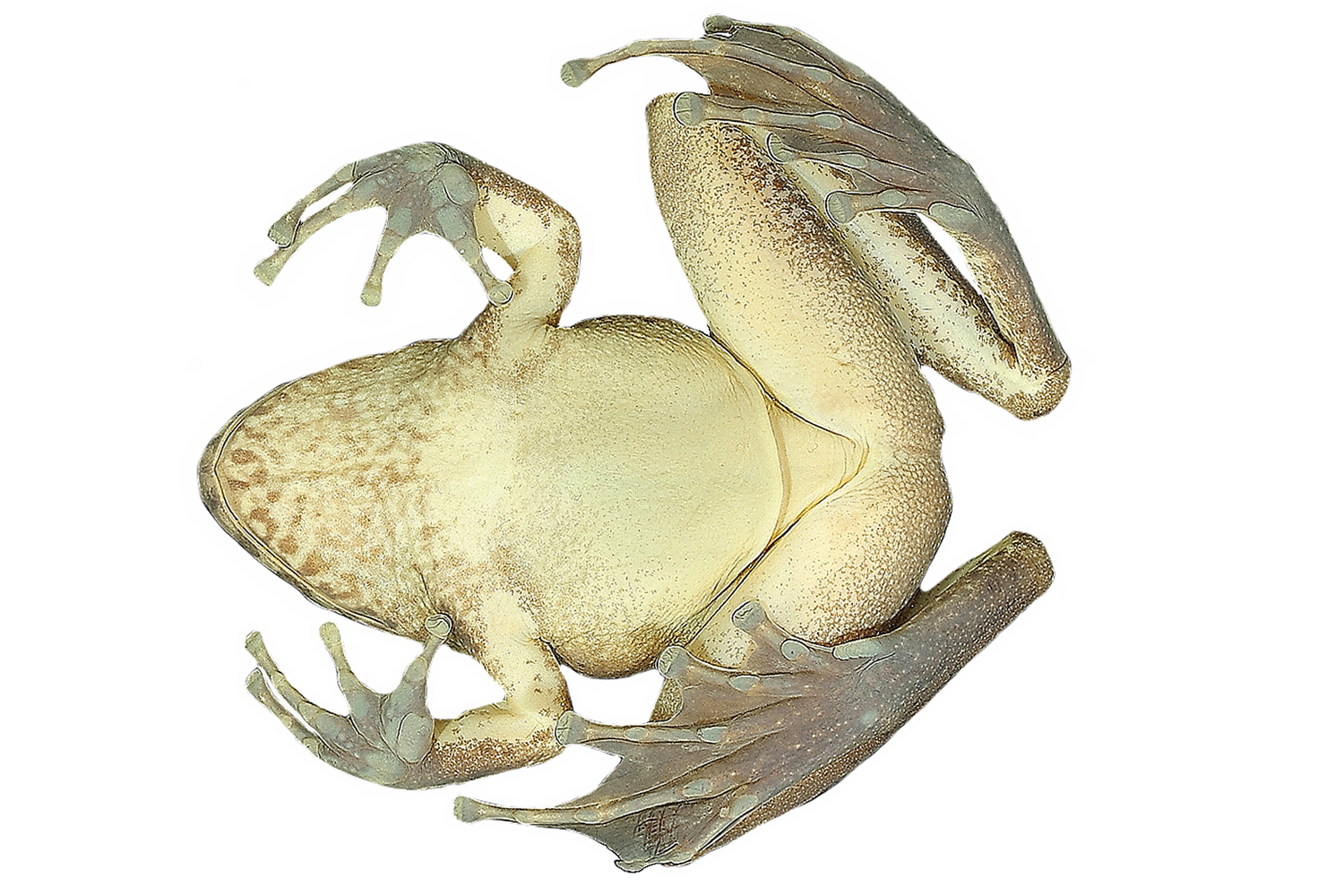
Es una rana mediana a grande de color café verdosa o rojiza. Vientre y muslos cremas o amarillos. Presenta más membrana entre los dedos de los pies que cualquier otra especie del género, excepto por Strabomantis zygodactylus de Colombia. Ambas especies tienen los dedos del pie completamente membranados, excepto por la última o las dos últimas falanges del Dedo IV. También se diferencia de otras especies del género por la ausencia de tubérculos en el párpado superior. En Ecuador, la especie más similar es Strabomantis anomalus, sin embargo, esta tiene la cabeza más ancha, no tiene discos en los dedos de la mano (discos pequeños en Strabomantis anatipes) y tiene un pliegue tarsal interno (ausente en Strabomantis anatipes) ( 1, 2). Pueden vivir en simpatría con varias especies de Pristimantis, pero estos se diferencian por tener el Dedo V del pie más largo que el Dedo III (dedo V más corto que Dedo III en Strabomantis anatipes).
Description
Es una rana de tamaño mediano a grande que presenta la siguiente combinación de caracteres ( 5): (1) piel dorsal finamente espiculada en machos, con pequeños tubérculos en hembras y vientre liso; pliegues discoidales prominentes; pliegues dorsolaterales interrumpidos; (2) cabeza más larga que ancha; hocico redondeado visto dorsalmente y truncado visto lateralmente, muy pequeño en machos; (3) canto rostral redondeado; región loreal cóncava; párpado superior sin tubérculos, mucho más ancho que la distancia interorbital; crestas craneales ausentes; (4) membrana timpánica evidente; anillo timpánico pequeño, escondido por espículas, 1/4 del tamaño del ojo, más visible en machos que en hembras; (5) odontóforos vomerinos triangulares y elevados; (6) Dedo I de la mano mucho más largo que el Dedo II; dedos sin rebordes laterales; discos de los dedos de las manos relativamente pequeños; (7) Dedo V del pie más corto que Dedo III; dedos membranados, las membranas se extienden hasta los discos, excepto por el Dedo IV, que se extiende hasta el tubérculo subarticuar; (8) tubérculos ulnares ausentes; tubérculos y pliegues de los talones y tarso ausentes; tubérculo metatarsal interno elongado y externo indistinto; tubérculos supernumerarios ausentes; (9) machos con sacos vocales y almohadillas nupciales presentes.
Color in Life
Dorso café rojizo o verdoso opaco con manchas naranja y crestas. Superficie oculta de los muslos e ingles color amarillo opaco y reticulado de negro. Región gular blanca con vermiculaciones cafés. Vientre y superficie ventral de las piernas color crema o amarillo. Barras labiales y supratimpánicas café obscuras, poco definidas. Barras café obscuras en las extremidades. Triángulo anal color café, poco definido. Iris bronce brillante con flecos negros y una línea horizontal café (1, 5).
Males Face Cloacal Length Average
promedio = 53.9 mm (42.9 –64.3; n = 4) (1
Females Face Cloacal Length Average
promedio = 98.6 mm (n = 1) (1
Habitat and Biology
Habita bosque tropical y bosque nublado de tierras bajas. Es una especie nocturna, terrestre y asociada a pequeños riachuelos y sus cercanías, pero no se la ha visto cerca de grandes ríos. Se la puede observar sentada en rocas, grietas rocosas o pendientes a lo largo de riachuelos, en bosque cerrado. Vive en simpatría con Strabomantis anomalus, Strabomantis bufoniformis y Strabomantis necerus en Ecuador y con Strabomantis cheiroplethus y Strabomantis zygodactylus en Colombia (1, 5).
Reproduction
Se presume que es una especie de desarrollo directo (6).
Distribution
Se conoce únicamente de dos localidades en las provincias de Carchi y Esmeraldas (1).
Global Distribution
Altitudinal Range
de 100 a 1600 metros sobre el nivel del mar
Taxonomy and Evolutionary Relationships
Según Lynch y Myers (5) esta especie está cercanamente relacionada a Strabomantis anomalus, Strabomantis zygodactylus, Strabomantis bufoniformis y Strabomantis necerus. Dentro del grupo de especies Strabomantis bufoniformis (3, 4).
Etymology
El epíteto específico proviene de las palabras en latin anatis que significa de pato y pes que significa pies, en referencia a la extensa membrana presente entre los dedos de los pies de esta especie (5).
Additional Information
Lynch y Duellman (1) presentan una fotografía en vida de un juvenil. Stuart et al. (7) presentan una fotografía, un mapa de distribución y comentan sobre el estado de conservación de la especie.
Summary Author
Caty Frenkel y Juan M. Guayasamín.
Editor
Juan M. Guayasamín.
Edition Date
2018-05-02T00:00:00
Update Date
2022-10-03T16:59:47.11
Literature Cited
Lynch, J. D. y Duellman, W. E. 1997. Frogs of the genus Eleutherodactylus in Western Ecuador: systematics, ecology, and biogeography. The University of Kansas, Natural History Museum, Special Publication 23:1-236.Enlace Hedges, S. B., Duellman, W. E. y Heinicke, M. P. 2008. New World direct-developing frogs (Anura: Terrarana): Molecular phylogeny, classification, biogeography, and conservation. Zootaxa 1737:1-182. Stuart, S. N., Hoffmann, M., Chanson, J., Cox, N., Berridge, R., Ramani, P. y Young, B (eds.). 2008. Threatened Amphibians of the World. Lynx Edicions. España xv+758pp. Lynch, J. D. y Myers, C. W. 1983. Frogs of the fitzingeri group of Eleutherodactylus in eastern Panama and Chocoan South America (Leptodactylidae). Bulletin of the American Museum of Natural History: 481-572.Enlace MECN. 2010. Serie Herpetofauna del Ecuador: El Choco Esmeraldeño. Monografía. Museo Ecuatoriano de Ciencias Naturales. Quito-Ecuador 5:1-232. Padial, J. M., Grant, T., Frost, D. R. 2014. Molecular systematics of terraranas (Anura: Brachycephaloidea) with an assessment of the effects of alignment and optimality criteria. Zootaxa 3825:1-132. IUCN. 2018. The IUCN red list of threatened species. http://www.iucnredlist.org/search. (Consultado: 2018).
|



 Map of Life