|
Description
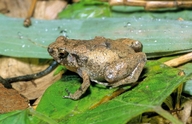
A small terrestrial microhylid, males measure about 15 mm. Back in adults
usually uniformly greyish. Young with two inverted V-shaped markings on the
greyish back. If distinct, the tubercles on the back are whitish. Skin on the
back is smooth, often with a few, rather large, tubercles. Tympanum rather
indistinct, tympanum/eye ratio less than 1/2. Tibiotarsal articulation reaches
the eye. Four fingers and 5 toes are present. There is no recognizable digital
reduction. Males with a distinct, largely distensible, single subgular vocal
sac.
Males called mainly in the evening, and also after sunset. Call consists of
a single, chirping note, louder than in Stumpffia pygmaea. Calls are
arranged in series, which last several minutes. Call duration is about 95-101
ms (mean 97 ms, n=10), intervals between the calls last 1375-2365 ms (mean
1670 ms, n=9), call repetition rate is about 45/min and frequency is 4.7 kHz.
Calls from Montagne d'Ambre were similar.
Mainly S. tetradactyla (digital reduction!) and S. psologlossa
(skin always smooth, different advertisement call). S. sp. from Sambava
is very similar. S. tridactyla and S. pygmaea have shorter
hindlimbs. S. grandis and S. roseifemoralis are larger.
Distribution and Habitat
Country distribution from AmphibiaWeb's database: Madagascar
Terra Typica: Benavony ; Ambanja ; Montagne d'Ambre.
Observed at elevations from sea level to about 900 m. They are usually
found in the leaf litter of cacao plantations and in the primary forest.
Life History, Abundance, Activity, and Special Behaviors
Eggs and tadpoles are unknown.
Comments
For references in the text, see here
References
Glaw, F. and Vences, M. (1994). Amphibians and Reptiles of Madagascar. M. Vences and F. Glaw Verlags GbR., Köln.
Originally submitted by: Frank Glaw and Miguel Vences (first posted 2001-10-30)
Edited by: Rachna Tiwari and Joyce Gross (2010-07-19)Species Account Citation: AmphibiaWeb 2010 Stumpffia gimmeli <https://amphibiaweb.org/species/2361> University of California, Berkeley, CA, USA. Accessed Apr 25, 2024.
Feedback or comments about this page.
Citation: AmphibiaWeb. 2024. <https://amphibiaweb.org> University of California, Berkeley, CA, USA. Accessed 25 Apr 2024.
AmphibiaWeb's policy on data use.
| 




 Map of Life