|
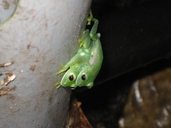
Vitreorana antisthenesi
| family: Centrolenidae subfamily: Centroleninae |
![]() © 2008 Aldemar A. Acevedo (1 of 8)
|
Country distribution from AmphibiaWeb's database: Venezuela
IUCN (Red List) status: Vulnerable (VU). |
|
Range Description This species is known from the northern versants of the Venezuelan Coastal Range, in the central region, and from the Cerro Azul, in Cojedes State, in the Serranía del interior. It has an altitudinal range between 220 and 1,200m asl. Habitat and Ecology It occurs in cloud forests and gallery forests. It lays its eggs on either side of leaves overhanging streams, and when hatched the larvae fall into the stream below where they develop further. Population The current population status of this species is not known. Population Trend Decreasing Major Threats Threats to this species are unknown, but the main threat is likely to be habitat loss due to smallholder farming activities, logging, burning, and human settlements. The Venezuelan Coastal Range is a highly modified habitat. Conservation Actions Some populations are within the Parque Nacional Henri Pittier and Rancho Grande in Aragua State. Further survey work is needed to determine the population status of this species. Taxonomic Notes Recently transferred from Hyalinobatrachium to Cochranella by Cisneros-Heredia and McDiarmid (2007). Citation Enrique La Marca, Jesús Manzanilla, Celsa Señaris 2004. Vitreorana antisthenesi. In: IUCN 2012
|