|
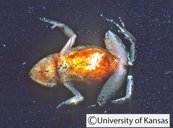
Aromobates haydeeae
| family: Dendrobatidae |
![]() © 2010 Division of Herpetology, University of Kansas (1 of 2) |
Country distribution from AmphibiaWeb's database: Venezuela
IUCN (Red List) status: Endangered (EN). |
|
Range Description This species is known from the Venezuelan Andean states of western Mérida and eastern Táchira. It has been recorded between 1,825 and 2,670m asl. Habitat and Ecology It occurs in clear, fast-flowing streams in Andean cloud forests, and in the puddles alongside the streams, and is sometimes hidden inside introduced "kikuyo" pasture grasses (Pennisetum clandestinum). The eggs are laid on land and the male protects the eggs. When they are hatched, the male carries the larvae on his back to water where they develop further. Population It is an uncommon species and is in decline. Population Trend Decreasing Major Threats Most of the species' original habitat has now been lost to agricultural activities (involving livestock and crops), and the remaining habitat is severely fragmented. Conservation Actions The species' range may be partially within Parque Nacional Los Paramos. Continued and strengthened management of this area, and expansion of the existing protected areas network to include other tracts of montane forest habitat in the Venezuelan Andes, are necessary. Citation Enrique La Marca, Juan Elías García-Pérez 2004. Aromobates haydeeae. In: IUCN 2012
|