
|
Rana fisheri Stejneger, 1893
Las Vegas Valley Leopard Frog Subgenus: Pantherana | family: Ranidae genus: Rana |
| Species Description: Stejneger, L. 1893. Annotated list of the reptiles and batrachians collected by the Death Valley Expedition in 1891, with descriptions of new species. North American Fauna 7: 159–228. | |
|
Taxonomic Notes: This species long was thought to be extinct, and if it is restricted to its type locality in the city of Las Vegas, Nevada, that is correct. In 2011 Hekkala, Saumure, Jaeger, Herrmann, Sredl, Bradford, Drabeck and Blum, in an open access article published in Conservation Genetics (DOI 10.1007/s10592-011-0229-6), showed that the closely related species Rana chiricahuensis includes two genetically distinct lineages. They were successful in obtaining sufficient genetic information from specimens of R. fisheri preserved in 1913 in ethanol and stored at the California Academy of Sciences to determine that it is a member of one of the two lineages, which is extant along the Mogollon Rim and White Mtns of central and eastern Arizona and extreme west-central New Mexico. The authors assigned this lineage to Rana fisheri, and accordingly, the species continues to exist. This species was placed in the genus Lithobates by Frost et al. (2006). However, Yuan et al. (2016, Systematic Biology, doi: 10.1093/sysbio/syw055) showed that this action created problems of paraphyly in other genera. Yuan et al. (2016) recognized subgenera within Rana for the major traditional species groups, with Lithobates used as the subgenus for the Rana palmipes group. AmphibiaWeb recommends the optional use of these subgenera to refer to these major species groups, with names written as Rana (Aquarana) catesbeiana, for example. |
|
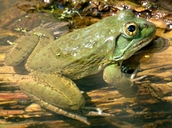 © 2013 Tara Sprankle (1 of 2) |
|
|


|
Description Heel of extended hind limb falls considerably short of snout tip (Stejneger 1893). Tympanic disc has vertical diameter greater than the distance between the nostrils and eye (Stejneger 1893). Vomerine teeth between choanae and projecting beyond choanae posteriorly (Stejneger 1893). Hind feet about 2/3 webbed (Stejneger 1893). Single small metatarsal tubercle (Stejneger 1893). Paired weak dorsolateral ridges, and lacking longitudinal folds between the dorsolateral ridges (Stejneger 1893). Skin is granular on posterior lower aspect of femur (Stejneger 1893). Dorsum and flanks with numerous small dark spots "surrounded by lighter" (Stejneger 1893). No black ear patch (Stejneger 1893). Although Stejneger (1893) stated that external vocal sacs were not present, Wright and Wright (1949) report the presence of vocal sacs both from field experience with live frogs and from preserved specimens. Olive green ground color, sometimes with the anterior body a brighter green, and with dark greenish olive to green spots. Spots often reduced or indistinct on anterior body/head, especially in males. Light stripes along dorsolateral folds. Throat light green with some pinkish suffusion, clouded with dark grayish olive green. Chest and belly may have pinkish cinnamon and may be clouded like the throat. Ventral surfaces of hindlimbs honey yellow to chamois. Males have nuptial pads. Females have more spotting dorsally than males (Wright and Wright 1949, from 1925 field notes on Tule Springs specimens, collected about 16 miles from what was Las Vegas at the time). Linsdale (1940) notes that R. fisheri had a "peculiar shade of ground color" compared to R. pipiens, but the shade is not otherwise described by that author. Holotype USNM 18957 (adult female) was collected on March 13, 1891 (Jennings 1988). Specimens collected at Vegas Valley in 1891 are at USNM (HerpNET); specimens are also present in the MVZ, Stanford and California Academy of Sciences collections (Wright and Wright 1949), and at LACM (HerpNET). Distribution and Habitat Country distribution from AmphibiaWeb's database: United States U.S. state distribution from AmphibiaWeb's database: Arizona, New Mexico, Nevada
Life History, Abundance, Activity, and Special Behaviors In field notes (MVZ) from 1942, Wright and Wright (1949) say: "May 16. What frog hunters we are! I thought I was good at it. I came here once with a golden spoon in my mouth. Seventeen years have gone since we were here last. Las Vegas has grown, but how? Thirty-five men sleeping on the Union Pacific lawn. Roads are changed. Took us most of the day to locate where the old artesian well and the springs were. At the U. S. Fish Hatchery found bullfrogs. The municipal golf course and possibly the hatcheries are where the springs were. Looked these over but no R. fisheri. Tried Las Vegas Creek upper stretches. Found a minnow and plenty of crayfish but no frogs. Trends and Threats Possible reasons for amphibian decline General habitat alteration and loss Comments Hillis and Wilcox (2005) also noted that populations of leopard frogs (characterized as R. chiricahuensis) from the Mogollon Rim, Arizona, may be referrable to R. fisheri, based on morphological similarity. In 2011, Hekkala and colleagues used ancient DNA methods with frogs fixed in ethanol in 1915 and preserved at the California Academy of Sciences to show that samples of R. fisheri cluster within the northwestern clade (of two clades currently assigned to Rana chiricahuensis), and they have assigned members of that clade (mainly from the Mogollon Rim region) to R. fisheri. The status of the second clade, currently R. chiricahuensis, is now in question, especially important given recent focus on conservation efforts.
References
HIllis, D. M., and Wilcox, T. P. (2005). ''Phylogeny of the New World true frogs (Rana).'' Molecular Phylogenetics and Evolution, 34, 299-314. Hekkala, E.R., Saumure, R.A., Jaeger, J.R., Herrmann, H-W., Sredl, M.J., Bradford, D.F., Drabeck, D., and Blum, M.J. (2011). ''Resurrecting an extinct species: archival DNA, taxonomy, and conservation of the Vegas Valley leopard frog.'' Conservation Genetics, published online 28 May 2011. Jennings, M. R. (1988). ''Rana onca Cope, relict leopard frog.'' Catalogue of American Amphibians and Reptiles. American Society of Ichthyologists and Herpetologists, 417.1-417.2. Jennings, M. R. and Hayes, M. P. (1994). ''Decline of native ranid frogs in the desert southwest.'' Herpetology of the North American Deserts, Special Publication, Number 5. P. R. Brown and J. W. Wright (Eds.), eds., Southwestern Herpetologists Society, Van Nuys, California. Jennings, R. D., Riddle, B. R. and Bradford, D. (1995). ''Rediscovery of Rana onca, the relict leopard frog, in southern Nevada with comments on the systematic relationships of some leopard frogs (Rana pipiens complex) and the status of populations along the Virgin River.'' Report prepared for Arizona Game and Fish Dept., U.S. Bureau of Land Management, Las Vegas Valley Water District, U.S. National Park Service, and Southwest Parks and Monuments Association. 73 pp. Linsdale, J. M. (1940). ''Amphibians and reptiles in Nevada.'' Proceedings of the American Academy of Arts and Sciences, 73(8), 197-257. Slevin, J.R. (1928). "The amphibians of western North America." Occasional Papers of the California Academy of Sciences, 16, 1-152. Stebbins, R. C. (2003). Western Reptiles and Amphibians, Third Edition. Houghton Mifflin, Boston. Stuart, S., Hoffmann, M., Chanson, J., Cox, N., Berridge, R., Ramani, P., Young, B. (eds) (2008). Threatened Amphibians of the World. Lynx Edicions, IUCN, and Conservation International, Barcelona, Spain; Gland, Switzerland; and Arlington, Virginia, USA. Wright, A. H. and Wright, A. A. (1949). Handbook of Frogs and Toads of the United States and Canada. Comstock Publishing Company, Inc., Ithaca, New York. Originally submitted by: Krystal Gong (first posted 2009-05-11) Edited by: Michelle S. Koo (2022-04-20) Species Account Citation: AmphibiaWeb 2022 Rana fisheri: Las Vegas Valley Leopard Frog <https://amphibiaweb.org/species/6859> University of California, Berkeley, CA, USA. Accessed Apr 24, 2024.
Feedback or comments about this page.
Citation: AmphibiaWeb. 2024. <https://amphibiaweb.org> University of California, Berkeley, CA, USA. Accessed 24 Apr 2024. AmphibiaWeb's policy on data use. |
 Map of Life