
|
Rana blairi Mecham, Littlejohn, Oldham, Brown & Brown, 1973
Plains Leopard Frog Subgenus: Pantherana | family: Ranidae genus: Rana |
|
Taxonomic Notes: This species was placed in the genus Lithobates by Frost et al. (2006). However, Yuan et al. (2016, Systematic Biology, doi: 10.1093/sysbio/syw055) showed that this action created problems of paraphyly in other genera. Yuan et al. (2016) recognized subgenera within Rana for the major traditional species groups, with Lithobates used as the subgenus for the Rana palmipes group. AmphibiaWeb recommends the optional use of these subgenera to refer to these major species groups, with names written as Rana (Aquarana) catesbeiana, for example. |
|
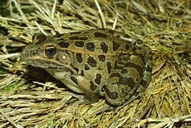 © 2009 Michael Graziano (1 of 7) |
|
|



|
Description Distribution and Habitat Country distribution from AmphibiaWeb's database: United States U.S. state distribution from AmphibiaWeb's database: Arkansas, Arizona, Colorado, Iowa, Illinois, Indiana, Kansas, Missouri, Nebraska, New Mexico, Oklahoma, South Dakota, Texas
Life History, Abundance, Activity, and Special Behaviors Trends and Threats
References
Brown, L. E. (1963). ''Rana blairi.'' Catalogue of American Amphibians and Reptiles. American Society of Ichthyologists and Herpetologists, 536.1- 536.6. Originally submitted by: April Robinson (first posted 2001-02-12) Species Account Citation: AmphibiaWeb 2001 Rana blairi: Plains Leopard Frog <https://amphibiaweb.org/species/4991> University of California, Berkeley, CA, USA. Accessed Apr 18, 2024.
Feedback or comments about this page.
Citation: AmphibiaWeb. 2024. <https://amphibiaweb.org> University of California, Berkeley, CA, USA. Accessed 18 Apr 2024. AmphibiaWeb's policy on data use. |
 Map of Life