|
Description
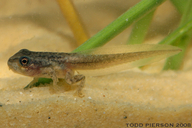
Pseudacris triseriata is a small hylid frog that can grow to 39 mm in length but averages 10-37 mm, with females larger than males. The color ranges from gray to brown dorsally, with a creamy venter. Dorsal markings may vary, but usually include three dark narrow, longitudinal stripes which may be broken up into three rows of spots. A dark triangle may occur between the eyes. A white stripe runs along the upper lip. Toes are unwebbed. Males have dark throats during breeding seasons. Distribution and Habitat
Country distribution from AmphibiaWeb's database: Canada, United States U.S. state distribution from AmphibiaWeb's database: Iowa, Illinois, Indiana, Kentucky, Michigan, New York, Ohio, Tennessee Canadian province distribution from AmphibiaWeb's database: Newfoundland and Labrador, Ontario, Quebec
They can be found throughout the state of Arkansas. They live in wooded areas near swamps and at the edge of marshes.Life History, Abundance, Activity, and Special Behaviors
The call of the male is a continous series of short trills, "Prreep-prreep-prreep," lasting for one or two seconds. Breeding occurs in late February or early March and ends by late April. Females lay from 500-1500 eggs total, in clusters of 20-100. Trends and Threats
This species of frog has adapted well to urbanization so it is not threatened.
References
Trauth, S. E., Robison, H. W., and Plummer, M. V. (2004). The Amphibians and Reptiles of Arkansas. The University of Arkansas Press, Fayetteville, Arkansas.
Originally submitted by: Peera Chantasirivisal (first posted 2005-10-06)
Edited by: Tate Tunstall (2008-01-03)Species Account Citation: AmphibiaWeb 2008 Pseudacris triseriata: Midland Chorus Frog <https://amphibiaweb.org/species/1061> University of California, Berkeley, CA, USA. Accessed Apr 20, 2024.
Feedback or comments about this page.
Citation: AmphibiaWeb. 2024. <https://amphibiaweb.org> University of California, Berkeley, CA, USA. Accessed 20 Apr 2024.
AmphibiaWeb's policy on data use.
|





 Map of Life