
|
Plethodon cinereus (Green, 1818)
Eastern Red-backed Salamander, Red-backed Salamander, (Northern Redback Salamander) Subgenus: Plethodon | family: Plethodontidae subfamily: Plethodontinae genus: Plethodon |
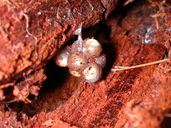 © 2005 Dave Blackburn (1 of 76) |
|
|



|
Description The body is long and fairly slender, is slightly flattened dorsally, and is well rounded on the sides. The cross section of the tail is nearly circular throughout its length. Regenerating tails are flattened laterally and are usually uniform dark gray. Number of costal grooves ranges from 17 to 20, but there are usually 18 or 19. The gular fold is prominent. The legs are small with short, thick toes. There are four fingers, which in order from longest to shortest are 3-2-4-1. The five toes are slightly webbed, and are 3-4-2-5-1 in order from longest to shortest. The vomerine teeth form two backward-curving lines of 5-7 teeth separated from each other and from the parasphenoid teeth, which are in two imperfectly separated patches. The mouth is fairly large, with the angle of the jaw behind the eye. The small tongue does not fill the floor of the mouth. Males can be identified when in breeding condition by swollen snout, enlarged premaxillary teeth, and proportionally longer legs (Bishop 1943). Black testes can also be seen through the abdominal wall when illuminated by a strong light (Jaeger et al. 2002a). The red-backed phase of this species is characterized by a broad, dorsal band running down the midline from the head onto the tail. The color of the stripe varies from light gray or dull yellow to pink, brick-red, and bright red. There are often small flecks of black within the band. The sides are dark gray or black, becoming lighter and mottled toward the belly, which is strongly mottled with white and gray. In contrast, the lead-backed phase lacks the dorsal band and is uniformly dark gray to almost black, with the head and legs usually lighter (Bishop 1943). There is also an erythristic color phase that is mostly red, apparently to mimic juvenile Notophthalmus viridescens (Tilley et al. 1982). Juveniles of the red-backed phase have a well developed dorsal band and the upper sides are strongly pigmented (Bishop 1943) As is the case for all members of the genus Plethodon, eggs are laid in terrestrial cavities attended by the female. The larval stage is passed within the egg capsule. The broad, flat, leaf-like gills rise from a common base, are often fully developed at hatching, and then persist for only a few days (Bishop 1943). Embryos average about 19 mm upon hatching and individuals less than 32 mm in snout-vent length are considered to be juveniles (Bishop 1943; Jaeger et al. 2002a). Juveniles have proportionately broad heads, which allows them to forage on a wide range of prey (Maglia 1996). The fingers and toes of the juveniles are well indicated, the inner and outer short (Bishop 1943). Distribution and Habitat Country distribution from AmphibiaWeb's database: Canada, United States U.S. state distribution from AmphibiaWeb's database: Connecticut, Delaware, Illinois, Indiana, Kentucky, Massachusetts, Maryland, Maine, Michigan, Minnesota, North Carolina, New Hampshire, New Jersey, New York, Ohio, Pennsylvania, Rhode Island, Tennessee, Virginia, Vermont, Wisconsin, West Virginia Canadian province distribution from AmphibiaWeb's database: New Brunswick, Nova Scotia, Ontario, Prince Edward Island, Quebec
Individuals of P. cinereus can be found beneath old logs, bark, moss, leaf mold, and stones in evergreen, mixed, and deciduous forests (Bishop 1943). P. cinereus prefers a moist environment and becomes more abundant and more active upon introduction of seeps (Grover 1998; Grover and Wilbur 2002). It also prefers a higher cover object density, which increases abundance and average body mass by making foraging more effective (Grover 1998). Life History, Abundance, Activity, and Special Behaviors P. cinereus is terrestrial and can often be found under cover objects such as logs (Bishop 1943). It also used earthworm burrows as refuges in experimental enclosures, resulting in higher survival rates over winter as well as lower predation risk from the common garter snake (Thamnophis sirtalis) when compared to encosures (Ransom 2010). During the summer noncourtship season, two-thirds of individuals are found alone, while the other third lives in male-female pairs (Gillette et al. 2000). Breeding takes place from October to December, during which time the pairs remain together (Bishop 1943). In the early spring, groups of 2-7 can be found together under rocks and logs (Jaeger 1979). Insemination takes place in the spring and eggs are laid in June and July (Bishop 1943; Lang and Jaeger 2000). Clutch size ranges from 3-14 eggs, usually from 8-10 (Bishop 1943; Ng and Wilbur 1995). The eggs are suspended by a common pedicel from the roof of the nest cavity, which is usually a well-rotted log (Bishop 1943). The females protect the eggs until they hatch 6-9 weeks later. Brooding females do not actively forage, but will eat opportunistically. This causes them to grow less than non-brooding females (Ng and Jaeger 1995). Females usually breed in alternate years because they normally require two years in order to store enough energy to yolk a clutch of ova and survive brooding. This is due to scarcity of prey (Jaeger et al. 2002a). P. cinereus, in the red-backed form, may avoid predation by mimicking the red eft (terrestrial) stage of the red-spotted newt, Notophthalmus viridescens, which is toxic; if so, this would be an example of Batesian mimicry since it is assumed that P. cinereus is not toxic (Brodie and Brodie 1980; Cassell and Jones 2005; Robertson 2010). Although Highton (1959) suggested that the most logical explanation for the observed dimorphism of P. cinereus is that the gene for striping (which makes the red-backed phase) is dominant to the gene for the unicolored, nonstriped condition (which makes the lead-backed phase), Highton (1975) observed that the striped morph was dominant in one Virginia locality but recessive in another (in a different county), and suggested that epistatic interaction of two or more loci was responsible for the dimorphism. Fitzpatrick et al. (2009), using model salamanders with and without dorsal stripes, found that the striping polymorphism was maintained due to frequency-dependent selection by ground-foraging wild birds. The two forms appear to differ in various ways: red-striped morphs were found to obtain prey with higher nutritional value than lead-backed morphs (Anthony et al. 2008); one study suggested that red-striped morphs have a different temperature threshold for above-ground activity, as they have higher metabolic rates (Moreno 1989), but another study did not find a consistent difference in metabolic rates (Petruzzi et al. 2006); red-striped forms were found to be less likely to flee from predators and less mobile than the lead-backed forms (Venesky and Anthony 2007); and red-striped morphs had lower stress hormone levels than the lead-phase form, possibly due to differential predation pressure (Davis and Milaonvich 2010). Amphibians harbor microsymbionts on their skin surfaces, which aid in defense against pathogens. Plethodon cinereus has been shown to harbor different species of bacteria on its skin that serve as part of the innate immune system and protect the salamander against fungal infections. These cutaneous bacteria include Janthinobacterium lividum, which secretes the antifungal metabolite violacein (Brucker et al. 2008a, 2008b), as well as the beneficial bacterium Lysobacter gummosus, which also has antifungal activity (Lauer et al. 2007). The bacterial species J. lividum has been shown to protect the salamander P. cinereus against infection by the chytrid fungal pathogen Batrachochytrium dendrobatidis, when it is present in sufficient numbers on the salamander's skin, and reduces clinical symptoms of the fungal disease chytridiomycosis in the salamanders (Brucker et al. 2008b; Harris et al. 2009b; Becker and Harris 2010). Bioaugmentation with this beneficial skin bacterium (J. lividum) in the laboratory appears to protect not only salamanders (P. cinereus) against chytridiomycosis (Harris et al. 2009b) but also at least one species of frog (Rana muscosa) (Harris et al. 2009a). The strategy of increasing beneficial skin bacteria (bioaugmentation) is now being tried in wild Rana muscosa frogs (Vredenburg pers. comm.), which carry some J. lividum on their skin but have been almost completely extirpated due to chytridiomycosis (Woodhams et al. 2007). P. cinereus has also been found to sometimes harbor an intracellular bacterium (order Rickettsiales, probably family Anaplasmatacea) within red blood cells. The bacteria live in a membrane-bound vacuole within the erythrocyte that appears as a cytoplasmic violet-colored inclusion following Giemsa staining. Inclusions were generally found in nucleated erythrocytes but occasionally also in enucleated erythrocytes. Davis et al. (2009) found that males were more likely to be infected than females and that infected salamanders were actually larger and had higher body condition scores than uninfected salamanders (even after accounting for gender). It is thought that the parasitic bacteria are likely to be transmitted by trombiculid mites. Trombiculid mites inhabit leaf litter and are the only ectoparasite known for salamanders in the genus Plethodon (Rankin 1937).
Abundance:
Inter-Specific Behaviors:
Foraging Habits:
When there are low prey densities, individuals have an indiscriminate diet and normally pursue prey. When there are high prey densities, individuals have a discriminate diet and normally ambush prey (Jaeger and Barnard 1981). Each individual learns through foraging experience which prey types are the most profitable. Gross caloric intake, which depends on size of the prey, and rate at which prey can be digested, which depends on the amount of chitin in the exoskeleton, are both factors that need to be considered (Jaeger and Rubin 1982). Thus, P. cinereus prefers termites to ants, because they are larger and have a softer exoskeleton (Gabor and Jaeger 1995). In individuals from higher-elevation habitat, stored tail fat relative to body size was found to be greater than in individuals from lower-elevation habitat (Takahashi and Pauley 2010).
Intra-Specific Behaviors:
These behaviors are often used to establish territoriality. Territories are used by both sexes to defend scarce prey and to avoid desiccation during rainless periods. In addition, they are used by males for courtship (Jaeger et al. 2002a; Lang and Jaeger 2000). Territories are established under cover objects, such as rocks and logs, and can be set within 5 days by placing pheromones on the substrate (Jaeger et al. 2002a). Home ranges for P. cinereus are about 1.15 m in diameter, and may be due to site tenacity, since the range of both adult (max 0.88 m) and juvenile (max 1.22 m) movement between years was roughly equal to the diameter of the home range (Ousterhout and Liebgold 2010). Scent markers are produced by the post-cloacal gland, so marking can be accomplished by touching the cloacal area to the substrate (Jaeger 1984; Simons et al. 1994). Fecal pellets are also used to mark territory (Jaeger et. al. 1986). An intruder can learn characteristics of the resident male, such as size, by sampling airborne odors through gular pumping, or by touching nasolabial cirri to the fecal pellets (Jaeger 1984; Simons et al. 1997). Females are more attracted to large males, males that have a prey-rich territory, and males that do not have odors from other females (Gillette et al. 2000). Females can discover how prey-rich a male's territory is by squashing his fecal pellets and seeing if it has the residue of light-armored termites or heavy armored ants (Jaeger et al. 1995a). Since prey-rich territories are the more valuable ones, both resident and intruder males are more aggressive when the resident has eaten higher quality food (Gabor and Jaeger 1995). During an invasion of another male's territory, both the intruder and defender assume threat posture about half the time (Jaeger et al. 1982). Both combatants are usually in ATR prior to biting attack, but the defender exhibits the higher rate of biting and successfully defends his territory 74% of the time (Jaeger et al. 1982; Jaeger 1984). Larger individuals are in general better competitors, and are thus more likely to hold the prey-rich territories (Mathis 1990). Since competition is normally harmful, neighboring males exhibit dear enemy recognition, which consists of less aggression and more submissive behavior towards territorial neighbors than toward strangers (Jaeger 1981). Females that are familiar with each other also spend less time in threat displays toward each other (Jaeger and Peterson 2002). Once a female has selected a male, the two of them form a pair and defend the territory together. In both the courtship and noncourtship seasons, males spend more time in aggression toward invading males than females do, and females spend more time in aggression toward invading females than males do. Thus, pairs can codefend a territory more successfully, but not in a cooperative manner. Their success can be seen in the fact that females spend less time intruding a territory defended by a pair than by a single individual, and that both female and male intruders spend less time on a pair's territory during courtship season than during noncourtship season. Still, the fact that the male and female of a pair cannot cooperate seems to indicate that males are not willing to pass up future polygynous relationships and females are not willing to pass up future polyandrous relationships (Lang and Jaeger 2000). To some extent, however, the relationship between the members of a pair is monogamous. During the noncourtship season, partners show no preference to associate with each other over novel conspecifics of the opposite sex. Even during the courtship season, they show no preference toward each other over single conspecifics of the opposite sex. At this time, however, they do prefer each other over paired conspecifics of the opposite sex. During the courtship season, the male profits from the presence of the female because it increases his reproductive fitness. As a result he undertakes mate guarding. The female profits from a monogamous male because with no other female in the territory she can obtain more prey for yolking ova (Gillette et al. 2000). The male takes this monogamous relationship so far as to punish a socially polyandrous female partner, meaning one who has foraged with another male. The male can sense if his partner has associated with another male by detecting the other male's pheromones on her skin. Punishment takes the form of increased used of threat postures and even nipping if it is during the courtship season. Males also stay farther away from female partners that are socially polyandrous during both the courtship and noncourtship seasons, while they spend more time touching socially monogamous female partners. Socially polyandrous females in response show an increase in escape behavior. This sort of sexual coercion on the part of the male is logical, because he should not allow polyandrous females to feed in his territory. This might mean investing his own resources on the offspring of another male (Jaeger et al. 2002a). Another interesting behavior among P. cinereus is the association between juveniles and adults. Juveniles normally inhabit the leaf litter between cover objects. They are attracted by the pheromones of adults and when the leaf litter dries out and foraging becomes difficult, they enter the adults' territories. Males are less aggressive toward juveniles than toward adult males and both male and female adults are more tolerant of juveniles with which they have cohabited previously. This type of behavior seems to be some sort of kin-selection. When it rains, the juveniles return to the leaf litter (Jaeger et. al. 1995b). A final fact about P. cinereus behavior is that they seem to exhibit a certain degree of homing ability. The average daily movement of individuals is only 0.43 m/day, yet when they are displaced 30 m, 90% of them return to their territories. This return is usually along a fairly straight path and is almost immediate. When displacement increases to 90 m, only 25% of individuals return to their territories (Kleeberger and Werner 1982). Trends and Threats The major threat is clearcutting, which has reduced salamander populations in the southern Appalachians by almost 9%, or more than one-quarter of a billion salamanders (Alford and Richards 1999). Logging exposes terrestrial salamanders to altered microclimates, increased soil compaction and desiccation, and reduced habitat complexity. Another threat is presented by invasive species of earthworms, which decrease forest leaf litter and thus habitat for the small arthropods that serve as prey items for salamanders. Maerz et al. (2009) conducted a mark-recapture study of woodland salamander abundance at ten sites in central New York and northeastern Pennsylvania, examining whether earthworm or plant invasions were associated with decreased salamander abundance. At these sites, P. cinereus constituted 80-99% of the salamanders captured. Salamander abundance was found to decline exponentially with decreasing leaf litter volume and was significantly associated with non-native earthworm abundance but not invasive plants. Earthworm invasions can be major drivers of change in temperate forests. It has also been suggested that salamanders in the vicinity of military installations might be at risk from high copper contamination (due to its use in bullet casings, shot, and explosives), based on toxicity studies (Bazar et al. 2008). Mercury accumulation might also pose a threat; salamanders from a contaminated site on the South River in Virginia had elevated mercury concentrations in their tissues, at much higher levels (14-fold higher) than those shown to negatively impact development and metamorphic success in the frog Rana sphenocephala. However, P. cinereus had much lower levels than the sympatric species Eurycea bislineata, probably due to life history (direct development in a terrestrial environment for P. cinereus vs. an aquatic larval stage and riverine association plus aquatic prey in the adult stage for E. bislineata) (Bergeron et al. 2010). Although some previous studies have shown that P. cinereusis sensitive to increased habitat acidity, Moore and Wyman (2010) reported that 87% of juveniles and 83% of adults were found under coverboards on a highly acidic forest floor (pH less than or equal to 3.8) in a northern hardwood forest of Québec, Canada. Possible reasons for amphibian decline General habitat alteration and loss Comments This species was featured as News of the Week on 5 December 2022: Lungs have been independently lost in some members of all three major amphibian groups – salamanders, frogs, and caecilians. However, lungs have been lost in just one frog and one caecilian species. Lungs are absent in a larger number of salamander species, having been lost in 11 of 89 species of hynobiids and all 497 species of the family Plethodontidae. Lewis et al. (2022) confirm that plethodontids actually initiate lung generation early in their development but the process is reversed through programmed cell death (apoptosis) before they emerge from the egg. Remarkably, the authors show that many of the genes that are involved in lung development in species that keep their lungs are also expressed in the vestigial lungs of plethodontids. This finding suggests that early lung development may be a necessary feature for the development of other organs, such as the heart. Because all plethodontids lack lungs, they were most likely lost in the common ancestor of the group between 66 million years ago (the timing of the first divergence events within the plethodontid crown clade) and 110 million years ago (the timing of the split between Plethodontidae and its sister family, Amphiumidae), thus showing that the retention of the genetic program underpinning lung development have been maintained for tens of millions of years despite the early loss of lungs in the plethodontid common ancestor. (Written by Jim McGuire) This species was featured as News of the Week on 6 June 2016: Eastern North American woodlands have been invaded by Asian earthworms, potent ecosystem engineers. They accelerate leaf litter decomposition and nutrient release, consume detritus, and alter edaphic properties, all potentially significant to co-occurring salamanders. An experimental lab and field study (Ziemba et al. 2016) examined the impact of invading earthworms on Eastern Red-backed Salamander, Plethodon cinereus, in Ohio. Salamanders use lower quality microhabitat and consume fewer prey in the presence of earthworms, and behave aggressively toward earthworms. Earthworms and salamanders share cover objects less often than random expectations. Earthworm abundance was negatively associated with abundance of some salamander classes. Loss of cover and physical exclusion of salamanders likely hinders salamander performance, Thus, a scenario following earthworm invasion is reduced recruitment and abundance. While P. cinereus is widespread and abundant and is not under immediate threat, related species with restricted geographic ranges might well face great threat from future earthworm invasion of their isolated ecosystems (Written by David B. Wake).
References
Alford, R.A., and Richards, S.J. (1999). ''Global amphibian declines: A problem in applied ecology.'' Annual Review of Ecology and Systematics, 30, 133-65. Anthony, C. D., Venesky, M. D., and Hickerson, C. A. M. (2008). ''Ecological separation in a polymorphic terrestrial salamander.'' Journal of Animal Ecology, 77, 646-653. Bazar, M. A., Quinn, M. J., Jr., Mozzachio, K., Bleiler, J. A., Archer, C. R., Phillips, C. T., and Johnson, M. S. (2008). ''Toxicological responses of red-backed salamanders (Plethodon cinereus) to soil exposures of copper.'' Archives of Environmental Contamination and Toxicology, 57, 116-122. Becker, M. H., and Harris, R. N. (2010). ''Cutaneous bacteria of the redback salamander prevent mortality associated with a lethal disease.'' PLoS One, 5(6), e10957. Bergeron, C. M., Bodinof, C. M., Unrine, J. M., and Hopkins, W. A. (2010). ''Mercury accumulation along a contamination gradient and nondestructive indices of bioaccumulation in amphibians.'' Environmental Toxicology and Chemistry, 29, 980-988. Bishop, S.C. (1943). Handbook of Salamanders. Comstock Publishing Company, Inc., Ithaca, New York. Brodie, E. D., Jr., and Brodie, E. D. III (1980). ''Differential avoidance of mimetic salamanders by free-ranging birds.'' Science, 208, 181-182. Bruce, R. C. (2008). ''Intraguild interactions and population regulation in plethodontid salamanders.'' Herpetological Monographs, 2008, 31-53. Brucker, R. M., Baylor, C. M., Walters, R. L., Lauer, A., Harris, R. N., and Minbiole, K. P. C. (2008). ''The identification of 2,4-diacetylphloroglucinol as an antifungal metabolite produced by cutaneous bacteria of the salamander Plethodon cinereus.'' Journal of Chemical Ecology, 43, 39-43. Brucker, R. M., Harris, R. N., Schwantes, C. R., Gallaher, T. N., Flaherty, D. C., Lam, B. A., and Minbiole, K. B. C. (2008). ''Amphibian chemical defense: Antifungal metabolites of the microsymbiont Janthinobacterium lividum on the salamander Plethodon cinereus.'' Journal of Chemical Ecology, 34, 1422-1429. Burton, T.M. (1975). ''Salamander populations and biomass in the Hubbard Brook Experimental Forest, New Hampshire.'' Copeia, 1975(3), 541-546. Cabe, P. R., Page, R. B., Hanlon, T. J., Aldrich, M. E., Connors, L., and Marsh, D. M. (2007). ''Fine-scale population differentiation and gene flow in a terrestrial salamander (Plethodon cinereus) living in a continuous habitat.'' Heredity, 98, 53-60. Cassell, R. W., and Jones, M. P. (2005). ''Syntopic occurrence of the erythristic morph of Plethodon cinereus and Notophthalmus viridescens in Pennsylvania.'' Northeastern Naturalist, 12, 169-172. Conant, R. and Collins, J.T. (1998). A Field Guide to Reptiles and Amphibians of Eastern and Central North America. 3rd Edition. Houghton Mifflin Company, Boston, Massachusetts. Davis, A. K. (2010). ''Lead-phase and red-stripe color morphs of red-backed salamanders Plethodon cinereus differ in hematological stress indices: A consequence of differential predation pressure?'' Current Zoology, 56, 238-243. Deitloff, J., Adams, D. C., Olechnowski, B. F. M., and Jaeger, R. G. (2008). ''Interspecific aggression in Ohio Plethodon: implications for competition.'' Herpetologica, 64, 180-188. Ducey, P.K., Schramm, K., and Cambry, N. (1994). ''Interspecific aggression between the sympatric salamanders, Ambystoma maculatum and Plethodon cinereus.'' American Midland Naturalist, 131, 320-329. Fitzpatrick, B. M., Shook, K., and Izally, R. (2009). ''Frequency-dependent selection by wild birds promotes polymorphism in model salamanders.'' BMC Ecology, 9, 12. Gabor, C.R., and Jaeger, R.G. (1995). ''Resource quality affects the agonistic bevariour of territorial salamanders.'' Animal Behavior, 49, 71-79. Gabor, C.R., and Jaeger, R.G. (1999). ''When salamanders misrepresent threat signals.'' Copeia, 1999(4), 1123-1126. Gillette, J. R., Jaeger, R.G., and Peterson, M.G. (2000). ''Social monogamy in a territorial salamander.'' Animal Behavior, 59, 1241-1250. Griffis, M. R., and Jaeger, R. G. (1998). ''Competition leads to an extinction-prone species of salamander: interspecific territoriality in a metapopulation.'' Ecology, 79, 2494-2502. Grover, M. C. (2000). ''Determinants of salamander distributions along moisture gradients.'' Copeia, 2000, 156-168. Grover, M. C., and Wilbur, H. M. (2002). ''Ecology of ecotones: interactions between salamanders on a complex environmental gradient.'' Ecology , 83, 2112-2123. Grover, M.C. (1998). ''Influence of cover and moisture on abundances of the terrestrial salamanders Plethodon cinereus and Plethodon glutinosis.'' Journal of Herpetology, 32, 489-497. Grover, M.C. and Wilbur, H.M. (2002). ''Ecology of ectones: interactions between salamanders on a complex environmental gradient.'' Ecology, 83, 2112-2123. Hairston, N.G. (1996). Long-term studies of vertebrate communities. Academic Press, New York, NY. Harris, R. N., Brucker, R. M., Walke, J. B., Becker, M. H., Schwantes, C. R., Flaherty, D. C., Lam, B. A., Woodhams, D. C., Briggs, C. J., Vredenburg, V. T., and Minbiole, K. P. C. (2009). ''Skin microbes on frogs prevent morbidity and mortality caused by a lethal skin fungus.'' The ISME Journal, 3, 818-824. Harris, R. N., Lauer, A., and Simon, M. A. (2009). '' Addition of antifungal skin bacteria to salamanders ameliorates the effects of chytridiomycosis.'' Diseases of Aquatic Organisms, 83, 11-16. Highton, R. (1959). ''The inheritance of the color phases of Plethodon cinereus.'' Copeia, 1959(1), 33-37. Highton, R. (1975). ''Geographic variation in genetic dominance of the color morphs of the red-backed salamander, Plethodon cinereus.'' Genetics, 80, 363-374. Highton, R. (1995). ''Speciation in eastern North American salamanders of the genus Plethodon.'' Annual Review of Ecology and Systematics, 26, 579-600. Highton, R. (1999). ''Geographic protein variation and speciation in the salamanders of the Plethodon cinereus group with the description of two new species.'' Herpetologica, 55, 43-90. Highton, R. (2000). ''Detecting cryptic species using allozyme data.'' The Biology of Plethodontid Salamanders. R.C. Bruce, R.G. Jaeger, and L.D. Houck, eds., Kluwer Academic/Plenum Publishers, New York, New York, 215-241. Highton, R., and Webster, T.P. (1976). ''Geographic protein variation and divergence in populations of the salamander Plethodon cinereus.'' Evolution, 30, 33-45. Jaeger, R.G. (1978). ''Plant climbing by salamanders periodic availability of plant dwelling prey.'' Copeia, 1978(4), 686-691. Jaeger, R.G. (1979). ''Season spatial distribution of the terrestrial salamander Plethodon cinereus.'' Herpetologica, 35, 90-93. Jaeger, R.G. (1980). ''Density-dependent and density-independent causes of extinction of a salamander population.'' Evolution, 34, 617-621. Jaeger, R.G. (1980). ''Fluctuations in prey availability and food limitation for a terrestrial salamander Plethodon cinereus.'' Oecologia, 44, 335-341. Jaeger, R.G. (1981). ''Dear enemy recognition and the costs of aggression between salamanders.'' Animal Behavior, 29, 1100-1105. Jaeger, R.G. (1981). ''Foraging tactics of a terrestrial salamander Plethodon cinereus choice of diet in structurally simple environments.'' American Naturalist, 117, 639-664. Jaeger, R.G. (1984). ''Agonistic behavior of the Red-Backed Salamander Plethodon cinereus.'' Copeia, 1984(2), 309-314. Jaeger, R.G. and M.G. Peterson (2002). ''Familiarity affects agonistic interactions between female Red-Backed Salamanders.'' Copeia, 2002(3), 865-869. Jaeger, R.G., Gabor, R.C., and Wilbur, H.M. (1998). ''An assemblage of salamanders in the southern Appalachian mountains: competitive and predatory behavior.'' Behavior, 135, 795-821. Jaeger, R.G., Gillette, J.R., and Cooper, R.C. (2002). ''Sexual coercion in a territorial salamander: males punish socially polyandrous female partners.'' Animal Behavior, 63, 871-877. Jaeger, R.G., Goy, J., Tarver, M., and Marqez, C. (1986). ''Salamander Plethodon cinereus territoriality pheromonal markers as advertisement by males.'' Animal Behavior, 34, 860-864. Jaeger, R.G., Kalvarsky, D., and Shimizu, N. (1982). ''Territorial behavior of the Red-Backed Salamander Plethodon cinereus expulsion of intruders.'' Animal Behavior, 30, 490-496. Jaeger, R.G., Prosen, E.D., and Adams, D.C. (2002). ''Character displacement and aggression in two species of terrestrial salamanders.'' Copeia, 2002(2), 391-401. Jaeger, R.G., Schwarz, J., and Wise, S.E. (1995). ''Territorial male salamanders have foraging tactics attractive to gravid females.'' Animal Behavior, 49, 633-639. Jaeger, R.G., Wicknick, J.A., Griffis, M.R., and Anthony, C.D. (1995). ''Socioecology of a terrestrial salamander: juveniles enter adult territories during stressful foraging periods.'' Ecology, 76, 533-543. Jaeger, R.G., and Rubin, A.M. (1982). ''Foraging tactics of a terrestrial salamander judging prey profitability.'' Journal of Animal Ecology, 51, 167-176. Kleeberger, S.R. and Werner, J.K. (1982). ''Home range and homing behavior of Plethodon cinereus in northern Michigan.'' Copeia, 1982(2), 409-415. Lang, C. and R.G. Jaeger (2000). ''Defense of territories by male-female pairs in the Red-Backed Salamander (Plethodon cinereus).'' Copeia, 2000(1), 169-177. Lauer, A., Simon, M. A., Banning, J. L., André, E., Duncan, K., and Harris, R. N. (2007). ''Common cutaneous bacteria from the eastern red-backed salamander can inhibit pathogenic fungi.'' Copeia, 2007, 630-640. Maerz, J. C., Nuzzo, V. A., and Blossey, B. (2009). ''Declines in woodland salamander abundance associated with non-native earthworm and plant invasions.'' Conservation Biology, 23, 975-981. Maglia, A.M. (1996). ''Ontogeny and feeding ecology of the Red-Backed Salamander Plethodon cinereus.'' Copeia, 1996(3), 576-586. Mathis, A. (1990). ''Territoriality in a terrestrial salamander the influence of resource quality and body size.'' Behavior, 112, 162-175. Mitchell, J.C. and Woolcott, W.S. (1985). ''Observations of the microdistribution diet and predator-prey size relationships in the salamander Plethodon cinereus from the Virginia Piedmont.'' Virginia Journal of Science, 36, 281-288. Moore, J.-D., and Wyman, R. L. (2010). ''Eastern red-backed salamanders (Plethodon cinereus) in a highly acid forest soil.'' The American Midland Naturalist, 163, 95-105. Moreno, G. (1989). ''Behavioral and physiological differentiation between the color morphs of the salamander Plethodon cinereus.'' Journal of Herpetology, 23, 335-341. Ng, M.V. and Wilbur, H.M. (1995). ''The cost of brooding in Plethodon cinereus.'' Herpetologica, 51, 1-8. Ousterhout, B. H., and Liebgold, E. B. (2010). ''Dispersal versus site tenacity of adult and juvenile red-backed salamanders (Plethodon cinereus).'' Herpetologica, 66, 269-275. Petruzzi, E. E., Niewiarowski, P. H., and Moore, F. B.-G. (2006). ''The role of thermal niche selection in maintenance of a colour polymorphism in redback salamanders (Plethodon cinereus).'' Frontiers in Zoology, 3, 10, doi:10.1186/1742-9994-3-10. Rankin, J. S. (1937). ''An ecological study of parasites of some North Carolina salamanders.'' Ecological Monographs, 7, 169-269. Ransom, T. S. (2010). ''Earthworms, as ecosystem engineers, influence multiple aspects of a salamander’s ecology.'' Oecologia, published online 17 September 2010, DOI: 10.1007/s00442-010-1775-1. Ransom, T. S., and Jaeger, R. G. (2006). ''An assemblage of salamanders in the southern Appalachian Mountains revisited: competitive and predatory behavior.'' Behaviour, 143, 1357-1382. Robertson, J. (2010). ''Mimicry: experimental design and scientific logic.'' An Introduction to Methods and Models in Ecology, Evolution, and Conservation Biology. S. Braude and B. S. Low, eds., Princeton University Press, Princeton, NJ. Simons, R.R., Gelgenhauer, B.E., and Jaeger, R.G. (1994). ''Salamander scent marks: site of production and their role in territorial defence.'' Animal Behavior, 48(11), 97-103. Simons, R.R., Jaeger, R.G., and Gelgenhauer, B.E. (1997). ''Competitor assessment and area defense by territorial salamanders.'' Copeia, 1997(1), 70-76. Takahashi, M. K. and Pauley, T. K. (2010). ''Resource allocation and life history traits of Plethodon cinereus at different elevations.'' The American Midland Naturalist, 163, 87-94. Tilley, S.G., Lundrigan, B.G., and Brower, L.P. (1982). ''Erythrism and mimicry in the salamander Plethodon cinereus.'' Herpetologica, 38, 409-417. Venesky, M. D., and Anthony, C. D. (2007). ''Antipredator adaptations and predator avoidance by two color morphs of the eastern red-backed salamander Plethodon cinereus.'' Herpetologica, 63, 450-458. Woodhams, D. C., Vredenburg, V. T., Simon, M. A., Billheimer, D., Shakhtour B., et al. (2007). ''Symbiotic bacteria contribute to innate immune defenses of the threatened mountain yellow-legged frog, Rana muscosa.'' Biological Conservation, 138, 390-398. Originally submitted by: Christopher Searcy, Kellie Whittaker (first posted 2003-01-09) Trends and threats by: Michelle S. Koo (updated 2021-03-17)
Edited by: Kellie Whittaker, Ann T. Chang, Michelle S. Koo (2022-12-04) Species Account Citation: AmphibiaWeb 2022 Plethodon cinereus: Eastern Red-backed Salamander <https://amphibiaweb.org/species/4126> University of California, Berkeley, CA, USA. Accessed Apr 19, 2024.
Feedback or comments about this page.
Citation: AmphibiaWeb. 2024. <https://amphibiaweb.org> University of California, Berkeley, CA, USA. Accessed 19 Apr 2024. AmphibiaWeb's policy on data use. |
 Raffaëlli Account
 Map of Life