AMPHIBIAWEB
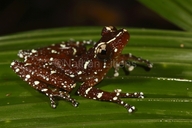
Nyctixalus pictus
Peter's Tree Frog
family: Rhacophoridae
subfamily: Rhacophorinae

© 2009 Lars Fehlandt (1 of 6)
Country distribution from AmphibiaWeb's database: Indonesia, Malaysia, Philippines, Singapore, Thailand, Viet Nam

Malaysian region distribution from AmphibiaWeb's database: Peninsular Malaysia, Sabah, Sarawak

View distribution map using BerkeleyMapper.

IUCN (Red List) status: Near Threatened (NT).
For Red List information on this species, see the IUCN species account.

Can you confirm these amateur observations of Nyctixalus pictus?

Add your own observation of
Nyctixalus pictus »

Comments
For photos of Nyctixalus pictus adults and larvae and another species account, see www.frogsofborneo.org.

From the IUCN Red List Species Account:


Range Description

This species is found from Yala in extreme southern Thailand (Taylor 1962) through Peninsular Malaysia (Berry 1975), Singapore (Lim and Lim 1992), Sumatra (including Siberut in the Mentawai Islands) in Indonesia, northern parts of Borneo (both Malaysia and Indonesia), and Palawan in the Philippines. It is likely to occur a little more widely than current records suggest. It has been recorded from 50-700m asl.

Habitat and Ecology

Adults live in the shrub and lower tree strata in primary and secondary forests. This species breeds by larval development in arboreal water-filled cavities and in rotting logs.

Population

It is widespread but nowhere is it common.

Population Trend

Decreasing

Major Threats

The major threat is forest clearance due to agriculture and logging.

Conservation Actions

Its range includes several protected areas, but more effective protection of lowland rainforest is critical to ensure the persistence of this species.

Citation

Arvin Diesmos, Angel Alcala, Rafe Brown, Leticia Afuang, Genevieve Gee, Jeet Sukumaran, Norsham Yaakob, Leong Tzi Ming, Yodchaiy Chuaynkern, Kumthorn Thirakhupt, Indraneil Das, Djoko Iskandar, Mumpuni, Robert Inger, Robert Stuebing, Paul Yambun, Maklarin Lakim 2004. Nyctixalus pictus. In: IUCN 2012


IUCN Terms of Use